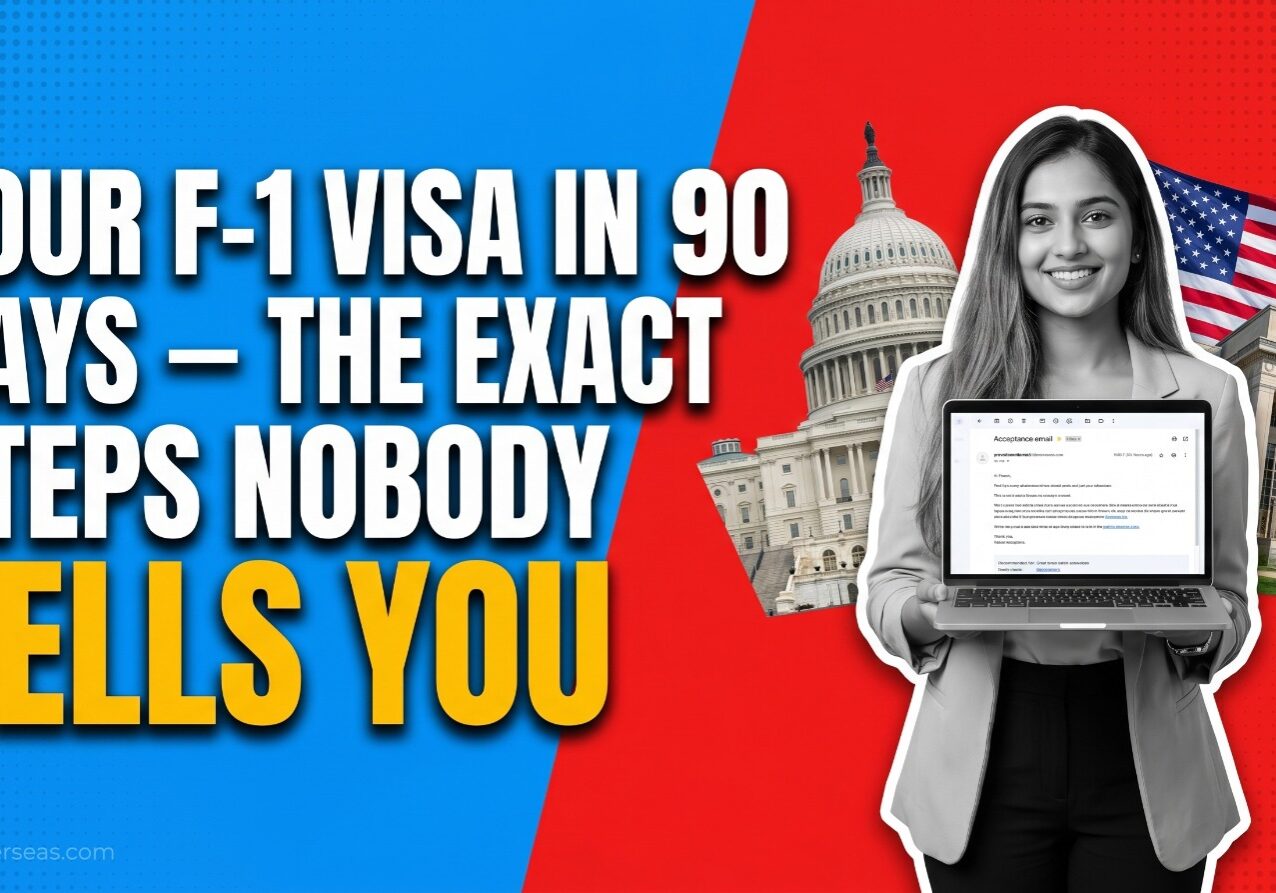
Your F-1 Visa in 90 Days — The Exact Steps Nobody Tells You
By ESM Overseas Visa Experts | Updated May 2026
⏱️ 22 min read · 4,275 words
What’s Inside This Guide
- The 90-Day F-1 Visa Roadmap — At a Glance
- What the F-1 Visa Actually Is (and Why That Matters for Your Interview)
- Days 1–14: Your I-20 and the SEVIS Fee — Where It All Starts
- Days 15–28: The DS-160, MRV Fee, and the New Visa Integrity Fee
- Days 25–45: Booking Your Visa Interview Slot
- Days 45–75: Building Your Document File — The Complete List
- Days 75–85: The Visa Interview — What Actually Happens
- What Most People Get Wrong — The Real Rejection Reasons
- A Section for Parents — What You Actually Need to Know
- Days 85–90: After the Interview — What Happens Next
- Frequently Asked Questions — Real Questions Students Ask
- You’ve Got This — And You Don’t Have to Figure It Out Alone
Your US acceptance letter just arrived. You’ve read it three times. Maybe you cried a little. Maybe your parents called every relative in the family group chat.
And then someone said, “Now you need the visa.”
That’s when the stomach drops.
Because the F1 visa process from India sounds simple until you actually start researching it. Suddenly there are six different fees, a dozen documents, a government interview, and ten people on YouTube giving you contradictory advice. One video says you need ₹40 lakh in your account. Another says ₹25 lakh is enough. Someone in a Facebook group says they got rejected because of the wrong photograph size.
We’ve guided 200+ students through this exact moment — the acceptance-to-visa stretch. And the truth is, this process is completely manageable when you know the actual steps in the actual order.
This guide breaks down the F-1 visa process step by step across a clear 90-day window. Not theory — the exact sequence our students follow to walk out of the US Consulate with a visa in their passport.
Let’s get into it.
The 90-Day F-1 Visa Roadmap — At a Glance
The F-1 visa process from India has a defined sequence. Skipping or swapping steps is one of the most common reasons for delays and rejections. Here’s the complete picture before we go deep:
| Phase | Timeframe | Key Action | Cost (approx.) |
|---|---|---|---|
| Phase 1: I-20 & SEVIS | Days 1–14 | Receive I-20, pay SEVIS I-901 fee | USD 350 (≈ ₹29,200) |
| Phase 2: DS-160 & MRV Fee | Days 15–25 | Complete DS-160 form, pay MRV fee | USD 185 (≈ ₹15,500) |
| Phase 3: Visa Integrity Fee | Days 20–28 | Pay new USD 250 Visa Integrity Fee | USD 250 (≈ ₹20,900) |
| Phase 4: Appointment | Days 25–45 | Book consulate interview slot | No additional fee |
| Phase 5: Document Prep | Days 45–75 | Gather, organise, and review all documents | Varies |
| Phase 6: Interview | Days 75–85 | Attend visa interview at US Consulate | — |
| Phase 7: Passport Return | Days 85–90 | Receive passport with visa stamped | — |
Total cost estimate: USD 785 (≈ ₹65,600) in government fees alone, not counting university application fees or consultant charges.
Screenshot this table and save it. Parents — this is the one to share in the WhatsApp group.
What the F-1 Visa Actually Is (and Why That Matters for Your Interview)
The F-1 student visa is a non-immigrant visa that allows Indian students to pursue full-time academic study at a US university or college approved by the Student and Exchange Visitor Program (SEVP). It is tied to your specific I-20 document, your specific university, and your specific program — which means changing any of these after you land has consequences.
Here’s why this definition matters for your interview: the consular officer’s single biggest job is to determine whether you genuinely intend to study and return to India after graduation. Everything in your application — your financial documents, your academic profile, your family ties — is evidence toward answering that one question.
According to ESM Overseas’ visa experts, the most common reason students from Punjab and Haryana get rejected is not weak financials or low GPA — it’s that they walk into the interview unable to clearly articulate why this university, why this program, why now. You can have ₹50 lakh in your account and still get a 221(g) refusal if your story doesn’t hold together.
Keep that frame in mind throughout this guide. Every document you gather is evidence. Every answer you prepare is part of a coherent story.
Days 1–14: Your I-20 and the SEVIS Fee — Where It All Starts
The I-20 is the document that makes everything else possible. It’s a certificate of eligibility issued by your university’s international student office, and you cannot apply for an F-1 visa without it.
After you pay your university’s enrollment deposit (typically USD 200–500), the international office will email your I-20 within 7–21 days. Some universities issue it faster — MIT and UC campuses are known for quick turnarounds. Others, especially smaller state universities, can take three weeks. Follow up proactively if you haven’t received it by Day 10.
The moment your I-20 arrives, check these four things:
- Your name matches your passport exactly — middle names included
- Your program start date gives you enough runway for the 90-day process
- The SEVIS ID number (starting with N) is printed clearly
- Your course of study matches what you applied for
Any mismatch? Contact your DSO (Designated School Official) immediately. A name error on the I-20 can delay your visa by weeks.
Pay the SEVIS I-901 Fee — Don’t Skip This
Before you do anything else, pay the SEVIS I-901 fee of USD 350 (approximately ₹29,200 at May 2026 rates) at fmjfee.com. This fee registers you in the Student and Exchange Visitor Information System — the database US immigration uses to track all international students.
Pay this in your own name, using your SEVIS ID from the I-20. Print or save the payment receipt. You will need it at your visa interview.
Important: Pay this fee before filling your DS-160. The SEVIS receipt number goes into the DS-160 form.
Days 15–28: The DS-160, MRV Fee, and the New Visa Integrity Fee
This is where most students lose time — either by rushing the DS-160 or by not knowing about the new Visa Integrity Fee introduced in 2025.
The DS-160 Online Application
The DS-160 is the US nonimmigrant visa application form, completed online at ceac.state.gov. It takes 60–90 minutes to fill out carefully. Do not rush it.
Key sections that students get wrong:
- Social media handles: The form now asks for all social media usernames. Be honest — they cross-check. If you’re on Instagram as @yourname, list it.
- Travel history: List every country you’ve visited, even on a school trip. Missing a Schengen stamp is a red flag.
- Sponsor information: If your parents are financing your education, list them as sponsors with their employment and income details.
- Purpose of trip: Write “Student — F-1 visa” and name your university. Keep it factual, not aspirational.
Once submitted, print the DS-160 confirmation page with the barcode. You cannot make changes after submission without starting a new form — so review every answer twice before hitting submit.
MRV Fee — USD 185
The Machine Readable Visa fee of USD 185 (approximately ₹15,500) is paid through the US Visa Application Centre (USVAC) portal in India. This fee pays for your visa application processing. It’s non-refundable, even if your visa is denied.
The New Visa Integrity Fee — USD 250
As of 2025, a new Visa Integrity Fee of USD 250 (approximately ₹20,900) applies to F-1 visa applicants. This fee is separate from the SEVIS fee and the MRV fee. It supports the Student and Exchange Visitor Program’s expanded verification processes. Pay this through the official SEVP portal — links are available through your university’s international student office.
In our experience helping students with their application assistance, missing this fee is one of the most common reasons for application processing delays in 2025–2026. Verify the current payment portal directly with your DSO — fee infrastructure occasionally updates.
Running total so far: USD 785 in government fees (≈ ₹65,600)
Days 25–45: Booking Your Visa Interview Slot
India has five US Consulate and Embassy locations: New Delhi, Mumbai, Chennai, Hyderabad, and Kolkata. Students from Punjab, Haryana, and Chandigarh are typically assigned to the New Delhi consulate — though you can choose any location based on appointment availability.
Book your interview through the official US Visa Appointment portal (ustraveldocs.com/in). You’ll need:
- Your DS-160 confirmation number
- Your passport number
- Your MRV fee payment receipt
As of May 2026, appointment wait times at New Delhi for student visas are running 3–6 weeks during peak season (April–August). If your program starts in August or September, book your appointment no later than mid-June.
Parent note: If your son or daughter is applying and their program starts August 20, they ideally need their visa passport back by August 1 to arrange flights, accommodation, and bank setup. Work backwards from that date when booking the interview.
If slots are scarce, check daily — cancellations open up frequently, especially mid-week. Some students check the portal at 6 AM and 11 PM when new slots often appear.
Days 45–75: Building Your Document File — The Complete List
Document preparation is where the visa is won or lost before you even walk into the consulate. Our team at study visa consultancy in Chandigarh has reviewed thousands of document packages. Here is the exact file you need.
Core Documents (Non-Negotiable)
- Valid passport — must be valid for at least 6 months beyond your program end date. If your passport expires in December 2027 and your program ends July 2028, renew it now.
- I-20 from your university — signed by both you and your DSO.
- DS-160 confirmation page — printed with the barcode.
- SEVIS I-901 fee receipt — showing your name and SEVIS ID.
- Visa Integrity Fee receipt — keep the email confirmation.
- MRV fee payment receipt.
- Appointment confirmation letter — printed from the portal.
- One passport-size photograph — 5cm x 5cm, white background, taken within the last 6 months. Check the exact specifications on the US Embassy India website — photograph rejections are common and avoidable.
Academic Documents
- Class 10 and Class 12 mark sheets and certificates
- Bachelor’s degree or transcripts (if applying for Master’s)
- GRE / GMAT / TOEFL / IELTS score reports
- University admission letter (official, on university letterhead)
- Scholarship letters if applicable
Financial Documents
- Bank statements for the last 6 months — for the sponsoring account
- Fixed deposit receipts if applicable
- Property documents or asset statements (supporting financial strength)
- Loan sanction letter from bank (if taking an education loan)
- Parent’s latest salary slips (3 months) or business income proof
- Income Tax Returns — last 2 years for sponsoring parent
Ties to India (Often Overlooked)
- Property documents in family name
- Siblings’ educational/employment documents (shows family roots)
- Letter of intent to return — not always required to submit, but helps you articulate your story
How Much Bank Balance Do You Actually Need?
This is the most-asked question in every WhatsApp group. Here’s an honest answer:
The general guideline is that your bank statements should show sufficient funds to cover your first year’s tuition plus living expenses. For a typical US university, that means USD 35,000–60,000 depending on the school — which translates to ₹29–50 lakh at current exchange rates.
However, the money doesn’t all need to be liquid. A combination of savings (₹15–20 lakh), fixed deposits (₹10–15 lakh), and a sanctioned education loan from a nationalised bank can together satisfy the officer. We’ve seen students from Ludhiana with ₹18 lakh in savings get approved when their loan documents were strong and their I-20 showed a scholarship reducing their total dues.
The statement should show stable balances over 6 months — not a sudden deposit of ₹20 lakh last week. Consular officers are specifically trained to spot “parked” funds.
For proper document preparation guidance tailored to your specific financial situation, speak to a consultant before submitting — a wrong financial document package is almost impossible to fix mid-process.
Days 75–85: The Visa Interview — What Actually Happens
The interview lasts 2–5 minutes on average. Yes, minutes. Everything the officer needs is already in the system from your DS-160 and SEVIS registration. The interview is a spot-check — they’re confirming that the person in front of them matches the application, and that you can explain your own story clearly.
The Day Before
- Organise all documents in a clear folder — originals on top, photocopies behind
- Dress formally but comfortably — you’ll be standing in queue for 2–3 hours
- Do not carry a laptop or large bag — lockers are available but it adds time
- Confirm the consulate address and nearest Metro station the night before
- Reach 30 minutes before your appointment time — lines build up fast
What They Ask — And How to Answer
In our experience with 200+ F-1 applications, these are the questions that come up in almost every New Delhi interview:
“Why this university?”
Name one specific thing — a professor’s research, a program ranking, an industry connection. “It has a good reputation” will not satisfy an officer. A student from Patiala who said “Professor Robert Chen’s work on semiconductor fabrication aligns with my thesis direction” had his visa approved in 3 minutes.
“Who is funding your education?”
Be specific. “My father is funding it. He runs a transport business in Ambala and we have ₹35 lakh saved, plus a ₹20 lakh loan from SBI.” Vague answers create doubt.
“What will you do after you graduate?”
Your answer must show intent to return to India. “I plan to return and work in the semiconductor sector in India — the industry is growing significantly and my specialisation will be valuable here.” You do not need to have a specific job offer — you need a believable future plan.
“Have you applied to other universities?”
Answer honestly. If you got into three schools and chose this one, say so and say why. Lying about other applications is a rejection risk.
“Do you have family in the US?”
If yes, say so. Don’t hide it. Having family in the US is not an automatic problem — but lying about it and being caught is an automatic rejection.
What Not to Do
- Do not memorise answers word for word — you’ll sound robotic and officers notice
- Do not argue with the officer or ask why if they say they need more documents
- Do not volunteer unnecessary information — answer what’s asked
- Do not bring your parents into the interview window — only the applicant stands there
What Most People Get Wrong — The Real Rejection Reasons
Visa rejections under Section 214(b) — the most common F-1 rejection — happen when the officer is not convinced that you will return to India after your studies. Here are the specific patterns we see repeatedly:
1. The “Sudden Money” Problem
If your bank statement shows ₹2 lakh in January, ₹3 lakh in February, and then ₹28 lakh in March — that’s a red flag. Officers call this “parking money.” The funds need to show up organically over time, or come from a clear source like a loan, property sale, or inheritance with documentation.
2. The “Any University” Mindset
Students who applied to 12 universities and chose the one that replied first often struggle to explain their choice. Your university selection needs a rationale. If you can’t explain why you chose Arizona State over Penn State, the officer reads it as low commitment to the program.
3. Weak Ties to India
A 22-year-old, unmarried, only child, with no job offer waiting in India, whose entire family lives in Canada — that profile requires extra evidence of ties. If this sounds like your situation, prepare: a letter from a company offering you post-graduation employment, a family business document, or property in your name can all help.
4. Documents That Don’t Tell a Consistent Story
Your DS-160 says your father earns ₹8 lakh annually. Your bank statement shows ₹40 lakh. That gap needs an explanation — maybe it’s family savings over 20 years, or a property sale. If the explanation isn’t clear in your documents, the officer will find it suspicious.
5. IELTS / TOEFL Score Below University’s Minimum
If your I-20 is from a university whose standard requirement is TOEFL 80 and you scored 67, the officer may question how you were admitted. Know the answer — many universities admit conditionally with an English language program. Be ready to explain the pathway.
A Section for Parents — What You Actually Need to Know
If you’re a parent reading this — in Chandigarh, Mohali, Jalandhar, or Hisar — this section is for you. Share it in your family group.
Your son or daughter’s visa success depends heavily on how their financial sponsorship is presented. Here’s what matters:
You do not need to be rich — you need to be documented. We’ve helped families with agricultural land worth ₹1.5 crore get their child a US student visa by properly documenting land ownership and the bank account where harvest income sits. We’ve also seen urban families with ₹60 lakh in FDs get rejected because the documents were not organised clearly.
The education loan is your friend. A sanctioned education loan from SBI, PNB, or Axis Bank shows the consular officer that a regulated Indian institution has also verified your creditworthiness. It’s not a sign of weakness — it’s a signal of financial seriousness.
Your employment stability matters. Three months of salary slips from a stable employer are more convincing than six months from a company nobody has heard of. If you’re self-employed, your ITR for the last two years is more important than anything else.
The 214(b) rejection is not the end. If your child’s visa is rejected, they can reapply immediately — there’s no waiting period. But they need to address the specific reason for rejection. Applying again with identical documents will produce an identical rejection. That’s where guidance matters.
At ESM Overseas, we work with families throughout this process — from I-20 receipt to post-visa orientation. Our office in Chandigarh (SCO 375-376, Sector 35B) has handled students from families with vastly different financial profiles, and our 90%+ study visa success rate reflects that the process is about presentation, not just finances.
Call us at +91-7087217801 for a free 15-minute call to understand where your child’s application stands.
Days 85–90: After the Interview — What Happens Next
If the officer approves your visa at the window, they will keep your passport and give you a slip. Your passport with the F-1 visa stamped inside will be delivered via Blue Dart courier to your registered address within 3–5 business days.
If the officer issues a 221(g) administrative processing slip, it means additional checks are needed. This is not a rejection — it’s a hold. Administrative processing can take 2–8 weeks. In the meantime, you cannot do much except wait and monitor your case status at ceac.state.gov. Do not book flights during administrative processing.
Once you have the visa stamp, verify:
- Your name matches your passport exactly
- Visa type reads “F-1”
- Issue date and expiry date are correct
- The SEVIS ID on the visa matches your I-20
Report any discrepancies to the consulate immediately — errors are rare but must be corrected before you travel.
Before You Book That Flight
You can enter the US no earlier than 30 days before your program start date listed on the I-20. Arriving earlier is not permitted on an F-1 visa. Plan your travel window carefully — international flights from Delhi or Mumbai to US cities typically require 14–20 hours of travel including layovers.
Start your study in USA preparation in parallel: open a US bank account application (some banks allow Indian students to apply before arrival), confirm housing, and register for orientation with your university’s international office.
Frequently Asked Questions — Real Questions Students Ask
How much bank balance do I need for a USA student visa in 2026?
Your bank statements should show funds sufficient to cover at least your first year of tuition and living expenses. For most US universities, that’s roughly USD 35,000–55,000 — or about ₹29–46 lakh at May 2026 exchange rates. A combination of savings, fixed deposits, and a sanctioned education loan from an Indian bank is acceptable. The funds must appear stable over 6 months — a sudden large deposit right before your interview raises red flags with consular officers.
How long does the F-1 visa process take from India?
The F-1 visa process from India typically takes 60–90 days from the date you receive your I-20. This includes paying fees, completing the DS-160, booking an appointment, preparing documents, attending the interview, and receiving your passport. During peak season (May–July), appointment slots at New Delhi fill up faster, so students targeting August or September program starts should begin the process immediately upon receiving their I-20.
What is the SEVIS fee and why do I have to pay it?
The SEVIS I-901 fee of USD 350 (approximately ₹29,200) registers you in the Student and Exchange Visitor Information System — the US government database used to track all international students. It is separate from your visa application fee and must be paid before you fill out the DS-160. You pay it at fmjfee.com using your SEVIS ID from your I-20. Keep the payment receipt — you must show it at your visa interview.
Can I get a US student visa if my IELTS score is low?
Yes, if your university has still issued you a valid I-20 — which means they’ve admitted you. Many US universities offer conditional admission with an English language bridging program if your IELTS or TOEFL score is below standard. At the visa interview, you’ll need to clearly explain this pathway. A score of 6.0 IELTS with a conditional offer and a strong financial and academic profile can still result in a visa approval. The officer is assessing your overall credibility, not only your English score.
What happens if my F-1 visa is rejected?
If rejected under 214(b), you can reapply immediately — there is no mandatory waiting period. However, reapplying with identical documents will typically produce the same result. You need to identify and address the specific reason for rejection — usually weak ties to India, inconsistent financial documents, or an unclear study plan. At ESM Overseas, we do free post-rejection consultations to help students understand what to strengthen before reapplying. Call us at +91-7087217801.
Do I need to show property documents for a US student visa?
Property documents are not mandatory, but they are very useful as evidence of strong ties to India. A family home, agricultural land, or commercial property in the parents’ name demonstrates that the family has roots in India — which directly addresses the 214(b) “immigrant intent” concern. If your financial profile is borderline (savings of ₹15–20 lakh, for example), property documents worth ₹50 lakh+ can significantly strengthen the application.
Which US consulate should I apply at — Delhi or Mumbai?
Students from Punjab, Haryana, and Chandigarh are typically in the Delhi consular district and should apply at the New Delhi US Embassy. However, you can legally apply at any US consulate or embassy in India regardless of your home state. If New Delhi appointments are fully booked and you need an earlier slot, check Mumbai or Hyderabad availability. The interview process and requirements are identical across all locations.
What is the Visa Integrity Fee and do I really have to pay it?
The Visa Integrity Fee of USD 250 (approximately ₹20,900) was introduced as part of updates to the SEVP program in 2025. It applies to F-1 visa applicants and is paid separately from the SEVIS fee and the MRV application fee. Your university’s international student office or DSO will have the exact payment portal link. This fee is mandatory for application processing — missing it will delay your case. Always verify current fee requirements directly with your DSO, as fee structures and payment portals update periodically.
You’ve Got This — And You Don’t Have to Figure It Out Alone
That was a lot. If your head is spinning slightly, that’s completely normal — and it’s actually a sign that you’re taking this seriously. The students who struggle in this process aren’t the ones who feel overwhelmed reading about it. They’re the ones who skip steps because they’re in a hurry, or who get advice from someone who went through this three years ago when the rules were different.
You’ve now read exactly what the F-1 visa process from India involves — the fees in order, the documents with actual amounts, the interview questions, and the real reasons applications fail. That already puts you ahead of 80% of students who walk into this process cold.
The next step isn’t more research. It’s a conversation with someone who has done this recently, repeatedly, and successfully.
At ESM Overseas, we’ve guided 200+ students from Punjab, Haryana, and Chandigarh through the F-1 process. Our 90%+ success rate comes from one thing: we look at each student’s specific profile — their university, their financials, their family situation — and build a strategy around that. Not a template. Your situation.
You’ve done the research. The next step is a 15-minute conversation with someone who’s guided hundreds of students through exactly what you’re facing right now. No pressure — just clarity on your specific situation.
Book your free consultation: Call or WhatsApp +91-7087217801
Or visit us at: SCO 375-376, Sector 35B, Chandigarh
Or get expert F-1 visa help by filling out our contact form — we respond within 4 business hours.