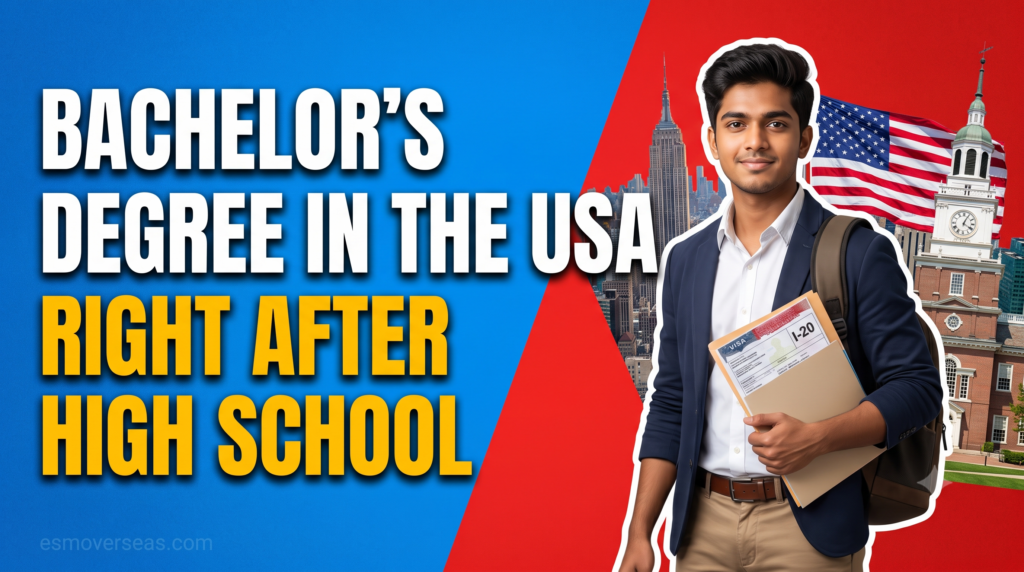
Why Study for a Bachelor’s Degree in USA Straight After Class 12?
Going for a Bachelor’s degree in USA right after high school lets Indian students join a four-year undergraduate program at 18, choose a major after exploring subjects in the first year, and graduate with globally recognised skills. It typically costs ₹25–60 lakh a year depending on the university, and takes about 8–12 months from shortlisting to visa approval.
For most students in Punjab, Haryana, and Chandigarh, the question isn’t whether a US Bachelor’s degree is valuable — it clearly is — but whether it’s the right fit for their child straight out of Class 12, and how to actually get there without wasting a year or a lakh of rupees on the wrong choices. This guide walks you through the entire journey: eligibility, costs, timelines, the application process, visa steps, and the questions parents ask us most often at our Chandigarh office.
Is a US Bachelor’s Degree Right After Class 12 a Good Idea?
In our experience handling 200+ undergraduate applications to the USA over the past few years, we’ve noticed that students who go straight from Class 12 to a US Bachelor’s program tend to adapt faster than those who take a gap year or start with a diploma elsewhere. American universities are built for 18-year-old freshmen — the entire first-year experience, from orientation to dorm life to the flexible “undeclared major” system, assumes you’re arriving straight from school.
That said, it’s not automatically the right choice for every student. A US Bachelor’s makes the most sense if your child:
- Isn’t fully sure which career path to pick (the US system lets you explore for a year or two before declaring a major)
- Wants exposure to project-based, discussion-heavy learning rather than pure lecture-and-exam formats
- Is aiming for careers in tech, business, engineering, or research where US degrees carry strong global recognition
- Has a family budget or scholarship plan that can realistically support 4 years of study
Eligibility: What You Need Right After Class 12
The good news is that eligibility requirements are fairly consistent across most US universities. Here’s what students from CBSE, ICSE, and Punjab/Haryana state boards typically need:
| Requirement | Typical Benchmark | Notes |
|---|---|---|
| Class 12 marks | 65% and above (varies by university tier) | Top 50 universities often prefer 85%+ |
| English proficiency | IELTS 6.5+ or TOEFL 80+ or Duolingo 105+ | Some universities now waive this for CBSE/ICSE English medium students |
| Standardised tests | SAT 1200+ (optional at many schools now) | Test-optional policies have expanded since 2023 |
| Essays (SOP/Personal Statement) | Common App essay + supplements | This is where most Indian applicants lose marks — generic essays |
| Letters of Recommendation | 2 from teachers, 1 from counsellor | Should highlight specific classroom examples, not just praise |
| Extracurriculars | Consistent involvement over 2+ years | Depth matters more than a long list |
Real Costs: What a US Bachelor’s Degree Actually Costs Indian Families
Cost is usually the first question parents ask us, and honestly it should be. Here are realistic, current-year figures based on the applications we’ve processed from our Chandigarh office:
| University Type | Annual Tuition (USD) | Annual Tuition (INR approx.) | Living Costs (INR/year) | Total per Year (INR) |
|---|---|---|---|---|
| State/Public Universities | $20,000 – $32,000 | ₹19 – 31 lakh | ₹7 – 10 lakh | ₹26 – 41 lakh |
| Private Universities (mid-tier) | $32,000 – $46,000 | ₹31 – 44 lakh | ₹8 – 12 lakh | ₹39 – 56 lakh |
| Ivy League / Top-Ranked Private | $58,000 – $70,000 | ₹56 – 67 lakh | ₹10 – 14 lakh | ₹66 – 81 lakh |
| Community College (2+2 pathway) | $9,000 – $15,000 | ₹9 – 14 lakh | ₹6 – 8 lakh | ₹15 – 22 lakh |
A four-year degree, therefore, can range anywhere from roughly ₹60 lakh (community college pathway) to over ₹3 crore (top private university, no scholarship) across the full duration. This is exactly why ESM Overseas’ visa experts always recommend building a balanced list of 6–8 universities — a mix of reach, match, and safety schools — so families have options at different price points before committing.
Ways to Reduce the Cost
- Merit scholarships: Many US universities offer automatic scholarships of $5,000–$20,000/year based on Class 12 marks and SAT scores, no separate application needed
- The 2+2 community college pathway: Complete 2 years at a community college, then transfer to a 4-year university — can save ₹15–25 lakh overall
- On-campus jobs: F-1 visa holders can work up to 20 hours/week on campus, covering some living expenses
- Need-based aid: A small number of universities (mostly top-tier) offer need-blind or need-aware aid to international students
Step-by-Step: How to Apply for a Bachelor’s Degree in USA
Here is the realistic timeline we walk families through at our Chandigarh office, starting roughly 12–14 months before the intended intake:
- Shortlist universities (Month 1–2): Build a balanced list of 6–8 universities based on budget, intended major, location, and admission chances.
- Plan and take standardised tests (Month 2–5): Register for SAT and IELTS/TOEFL if required; many universities are now test-optional, so this step depends on your target schools.
- Draft essays and gather documents (Month 4–7): Work on the Common App essay, supplemental essays, transcripts, and recommendation letters. This is usually the most time-intensive stage.
- Submit applications (Month 7–9): Most Early Decision/Early Action deadlines fall around November 1–15; Regular Decision deadlines are typically January 1–15.
- Receive admission decisions (Month 9–11): Decisions arrive between mid-December (Early rounds) and late March (Regular rounds).
- Accept offer and receive I-20 (Month 11): Confirm enrollment, pay the initial deposit, and the university issues your I-20 form, which is required for the visa application.
- Pay SEVIS fee and book F-1 visa interview (Month 11–12): Pay the $350 SEVIS I-901 fee and schedule your visa interview at the US Embassy or Consulate.
- Attend visa interview and prepare for departure (Month 12): Once the F-1 visa is approved (current processing plus interview wait times typically run 3–6 weeks in peak season), begin travel and accommodation planning.
For detailed help with any of these stages, our visa guidance team supports families through document preparation, interview practice, and SEVIS/DS-160 form filing.
The F-1 Student Visa Process, Explained Simply
Once you have your I-20 in hand, the visa process has a fairly fixed structure. Here’s what it involves:
- Pay the SEVIS I-901 fee ($350, roughly ₹29,000–₹30,000 depending on exchange rate)
- Complete the DS-160 online visa application form
- Pay the visa application (MRV) fee (currently $185, roughly ₹15,500)
- Schedule your F-1 visa interview at the nearest US Embassy or Consulate (Delhi, Mumbai, Chennai, Kolkata, or Hyderabad)
- Prepare financial documents proving funds for at least one year of tuition and living costs
- Attend the interview — be ready to explain your choice of university, intended major, and ties to India
In our experience preparing students for this interview, the most common reason for a rejection isn’t financial documentation — it’s students sounding rehearsed or unable to clearly explain why they chose their specific university and course. We run mock interview sessions at our Chandigarh office precisely to fix this before the real thing.
Popular Majors Among Indian Students
Based on the applications we’ve processed, these remain the most sought-after undergraduate majors among students from Punjab, Haryana, and Chandigarh:
- Computer Science and Data Science
- Business Administration and Finance
- Mechanical and Electrical Engineering
- Biotechnology and Pre-Med tracks
- Economics and Actuarial Science
Community College vs. Direct University Admission
One decision families often get stuck on is whether to apply directly to a 4-year university or start with a community college and transfer later. Both paths lead to the same Bachelor’s degree — here’s how they compare:
| Factor | Direct University Admission | Community College (2+2 Pathway) |
|---|---|---|
| Total 4-year cost | ₹1.05 crore – ₹3.25 crore | ₹60 lakh – ₹88 lakh |
| Admission difficulty | Higher (competitive SAT/essay-based process) | Lower (often open admission) |
| Campus experience | Full 4-year residential experience | 2 years commuter-style, then 2 years on university campus |
| Class sizes (Year 1–2) | Can be large lecture halls at big universities | Smaller, more personal attention |
| Best for | Students with strong academics and test scores | Budget-conscious families or students needing to raise grades/scores first |
Common Mistakes Indian Students Make
After guiding families through this process for several years, a few recurring mistakes stand out:
- Applying to only “dream” universities: Without safety schools, students risk ending up with no offers at all
- Generic essays: Reusing the same essay for every university without tailoring it to the specific program
- Underestimating living costs: Focusing only on tuition and being caught off guard by housing, food, and insurance costs
- Late SEVIS/visa scheduling: Waiting too long to book the visa interview slot, especially during the busy April–July season
- Ignoring scholarship deadlines: Many merit scholarships have earlier deadlines than the general application
Frequently Asked Questions
1. Can I apply for a US Bachelor’s degree directly after Class 12 in India?
Yes. Most US universities accept Indian Class 12 marksheets directly, with no need for a foundation year or diploma bridge, as long as you meet the academic and English proficiency requirements.
2. Is SAT compulsory for admission to US universities?
No, not anymore. A growing number of universities, including several well-known ones, have gone test-optional. However, a strong SAT score can still strengthen your application and help with scholarships.
3. How much does a Bachelor’s degree in the USA cost in total?
Total cost over four years typically ranges from around ₹60 lakh (public university or community college pathway) to over ₹3 crore (top private universities without scholarships), including tuition and living expenses.
4. Can international students work while studying in the USA?
Yes, F-1 visa holders can work up to 20 hours per week on campus during the academic session, and full-time during official breaks, subject to university rules.
5. How long does the F-1 student visa process take?
Once you have your I-20, the process — including SEVIS fee payment, DS-160 submission, and the interview — typically takes 3–6 weeks in peak season (May–August), though this can vary by consulate.
6. What is the minimum percentage required in Class 12 for US university admission?
There’s no fixed national cutoff, but most universities look for at least 65–70%, while top-ranked institutions typically expect 85% and above, along with strong extracurriculars and essays.
7. Can I change my major after starting my Bachelor’s degree in the USA?
Yes, this is one of the biggest advantages of the US system. Most students don’t have to declare a major until the end of their second year, giving them time to explore different subjects first.
8. Do I need an education loan for a US Bachelor’s degree, and how much can I get?
Many Indian families use education loans to cover part or all of the cost. Loan amounts depend on the bank and collateral offered, but can range from ₹20 lakh to over ₹1 crore. Our team can guide you on documentation for both collateral and non-collateral loan options.
How ESM Overseas Can Help
Choosing the right university, building a strong application, and navigating the F-1 visa process can feel overwhelming when you’re doing it for the first time — and most families are. That’s exactly why we exist. From our Chandigarh office, our team has personally guided over 200 students from Punjab, Haryana, and the tricity area through this journey, from the very first shortlist meeting to the day they board their flight.
Whether you’re just starting to explore your options or already have an I-20 in hand and need help preparing for your visa interview, our visa guidance services are built to make the process clear, honest, and stress-free — no jargon, no pressure.
Book Your Free 15-Minute Consultation
If you or your child is considering a Bachelor’s degree in the USA, we’d genuinely love to help you think it through — no obligation, no sales pitch. Just a straightforward 15-minute conversation about your goals, budget, and timeline.
Call or WhatsApp us at +91-7087217801, or visit our office at:
ESM Overseas
SCO 375-376, Sector 35B, Chandigarh
You can also reach out through our contact page to schedule a time that works for you. We look forward to helping you take this next big step, one honest conversation at a time.