Why So Many Indian Students Choose the USA After 12th Grade
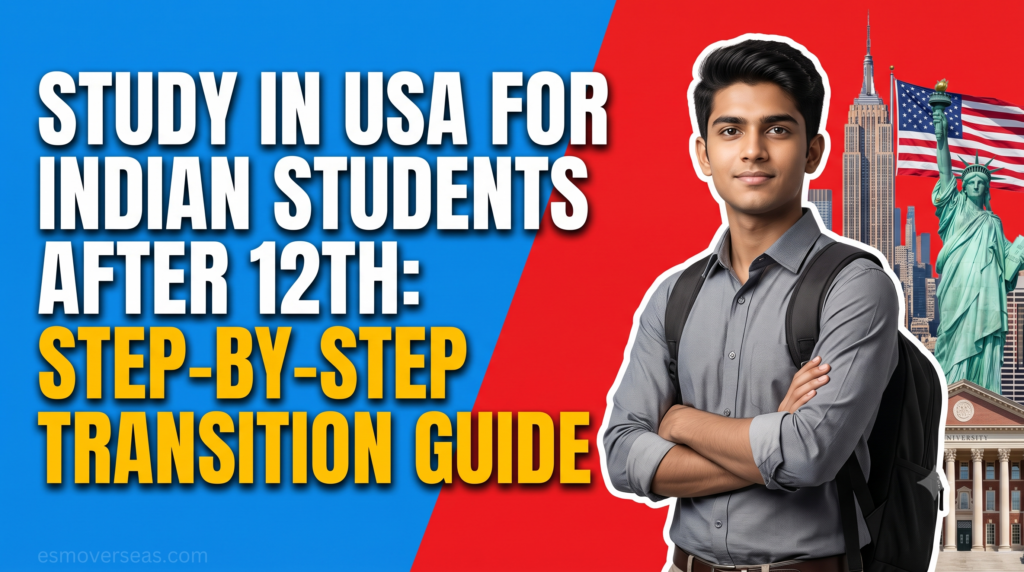
Studying in the USA after 12th means enrolling directly in a four-year Bachelor’s program at a US university, using your Class 12 marksheet, English proficiency scores (IELTS/TOEFL/Duolingo), and standardized tests like SAT or ACT where required. Most Indian students begin the process 12-15 months before their intended intake, applying to 6-8 universities and securing an F-1 student visa after admission.
Every year, thousands of students from Punjab, Haryana, and Chandigarh sit across our desk at SCO 375-376, Sector 35B, Chandigarh, asking the same question: “Is the USA really worth it after 12th, or should we wait for a Master’s?” In our experience handling 200+ applications for undergraduate study in the US, the honest answer is that it depends on your academics, budget, and long-term career goals — and this guide walks you through exactly how to figure that out, step by step.
The USA remains home to over 4,000 accredited universities offering flexibility that few other countries match — you can start with an “undeclared” major and choose your specialization after a year or two on campus. But the system is also more paperwork-heavy than the UK, Canada, or Australia, which is precisely why a structured transition plan matters.
USA vs Other Popular Study Destinations: A Quick Comparison
Before committing to the USA, it helps to see how it stacks up against the other countries Indian students commonly consider straight after 12th.
| Factor | USA | UK | Canada | Australia |
|---|---|---|---|---|
| Bachelor’s Duration | 4 years | 3 years | 4 years | 3 years |
| Average Annual Tuition | US$20,000–45,000 (₹19–43 lakh) | £15,000–25,000 (₹16–27 lakh) | CAD 20,000–30,000 (₹12–18 lakh) | AUD 25,000–40,000 (₹14–22 lakh) |
| Visa Type | F-1 Student Visa | Student Route Visa | Study Permit | Subclass 500 |
| Work While Studying | 20 hrs/week on-campus | 20 hrs/week | 20 hrs/week off-campus | 48 hrs/fortnight |
| Post-Study Work | OPT: 12 months (36 for STEM) | Graduate Route: 2 years | PGWP: up to 3 years | Temp Graduate visa: 2-4 years |
| Major Change Flexibility | High (undeclared major option) | Low (fixed at admission) | Moderate | Moderate |
As ESM Overseas’ visa experts often explain to families, the USA typically involves a higher upfront cost but offers unmatched flexibility in choosing and even changing your major, plus access to world-ranked universities across almost every field of study.
Step-by-Step: Your Transition Timeline From 12th to a US Campus
Here is the realistic, month-by-month roadmap we walk students through at our Chandigarh office.
- Class 11 / Early Class 12 (12-15 months before intake): Start preparing for SAT/ACT (if required by target universities) and IELTS/TOEFL/Duolingo. Build a shortlist of 8-10 universities across reach, match, and safety categories.
- June-August of Class 12: Register for and attempt SAT/ACT if needed. Begin drafting your Common App essay and personal statement.
- September-November: Finalize your university list (typically 6-8 applications), request Letters of Recommendation from teachers, and submit applications through the Common App, Coalition App, or individual university portals. Most Early Decision/Early Action deadlines fall in November.
- December-February: Complete pending Regular Decision applications (deadlines usually January 1-15). Appear for board exams while tracking application statuses.
- March-April: Receive admission decisions. Compare financial aid/scholarship offers and select your final university. Pay the enrollment deposit to receive your I-20 form.
- April-May: Once you have the I-20, pay the SEVIS I-901 fee (currently US$350) and schedule your F-1 visa interview at the US Embassy or Consulate (Chandigarh applicants typically go through New Delhi or Chandigarh’s VAC).
- May-June: Attend your visa interview, prepare financial documents, and await visa stamping. Processing after interview is usually 3-7 working days, though it can extend during peak season.
- July-August: Book flights, arrange accommodation, attend university’s international student orientation, and fly out — most Fall intakes begin in mid-to-late August.
Missing even one of these windows — especially the SAT registration or Early Decision deadlines — can push your entire plan back by a full year, which is why we recommend starting the process during Class 11 wherever possible.
Understanding the Real Cost: Tuition, Living Expenses, and Hidden Costs
One of the biggest reasons families hesitate on the USA is cost uncertainty. Here’s a realistic breakdown based on the cases we’ve handled through our visa guidance services over the past year.
| Expense Category | Public University (Annual) | Private University (Annual) |
|---|---|---|
| Tuition Fees | US$20,000–30,000 (₹19–29 lakh) | US$35,000–55,000 (₹34–53 lakh) |
| On-Campus Housing & Meals | US$10,000–14,000 (₹9.6–13.4 lakh) | US$12,000–16,000 (₹11.5–15.4 lakh) |
| Health Insurance | US$1,500–2,500 (₹1.4–2.4 lakh) | US$1,500–2,500 (₹1.4–2.4 lakh) |
| Books & Supplies | US$1,000–1,500 (₹96,000–1.4 lakh) | US$1,000–1,500 (₹96,000–1.4 lakh) |
| Personal Expenses | US$2,000–3,000 (₹1.9–2.9 lakh) | US$2,000–3,000 (₹1.9–2.9 lakh) |
| Approximate Annual Total | ₹33–49 lakh | ₹50–75 lakh |
Beyond tuition, families should budget separately for one-time costs: SEVIS fee (US$350), visa application fee (US$185), SAT/TOEFL/IELTS registration (₹15,000-25,000 combined), and flight tickets (₹65,000-1,20,000 round trip depending on season). Many state universities in the Midwest and South offer significantly lower tuition than the coastal private schools, and merit scholarships can shave 20-50% off the sticker price for strong academic profiles — something our counsellors actively help students negotiate for.
The F-1 Visa Process: What Actually Happens
The F-1 student visa is where most families feel the most anxious, and understandably so. Here is what the process genuinely looks like in 2026.
- Receive your I-20: Issued by your university after you pay the enrollment deposit. This is the document that makes you eligible to apply for an F-1 visa.
- Pay the SEVIS I-901 fee: Currently US$350, paid online before your visa interview.
- Complete the DS-160 form: The online nonimmigrant visa application form — accuracy here matters enormously, as inconsistencies are a common reason for delays.
- Schedule your visa interview: Book your slot at the nearest US Embassy or Consulate. Wait times for interview appointments vary by season, often extending during the April-July peak.
- Prepare your documentation: Financial proof (bank statements, education loan sanction letter, or sponsor affidavits), academic transcripts, I-20, SEVIS receipt, and a clear, honest explanation of your study plans and post-graduation intentions.
- Attend the interview: Typically lasts 3-5 minutes. Consular officers assess your intent to study, financial capability, and ties to India.
- Await visa stamping: If approved, passport with visa stamp is usually returned within 3-7 working days, though this can stretch during busy months.
In our experience handling 200+ applications, the single biggest reason for visa refusals isn’t financial documentation — it’s students being unable to clearly and confidently articulate why they chose their specific university and course. We run mock interview sessions with every student at our Chandigarh office precisely to fix this gap before the real interview.
Choosing the Right University: Beyond Just Rankings
Parents often ask us to shortlist only “top 50” universities, but rankings alone can be misleading for undergraduate study. As ESM Overseas’ visa experts advise, consider these factors together:
- Location and climate: A student from Punjab may find New England winters or extreme Midwest cold a genuine adjustment — factor this into your shortlist.
- Cost of living in the surrounding city: A university in a small college town often costs 30-40% less to live in than one in a major metro.
- Scholarship generosity: Some mid-ranked private universities offer far more merit aid to international students than elite public flagships.
- Indian student community: A visible, active Indian student association can ease homesickness significantly during the first year.
- Career services and OPT support: Strong internship pipelines matter more long-term than raw prestige for most students.
We always recommend applying to a genuine mix — 2 reach schools, 3-4 match schools, and 2 safety schools — rather than only chasing brand names. This balanced approach through our USA study programs page has consistently given our students both admission options and scholarship leverage.
Common Mistakes Indian Students Make (And How to Avoid Them)
| Mistake | Why It Hurts | How to Avoid It |
|---|---|---|
| Starting SAT prep too late | Rushed scores, limited retake attempts | Begin in Class 11, take SAT/ACT at least twice |
| Generic Common App essays | Fails to stand out among thousands of applicants | Write specific, personal stories, not generic achievements |
| Applying to only “dream” universities | High rejection risk, no fallback | Balance reach, match, and safety schools |
| Weak financial documentation | Visa delays or refusal | Prepare loan sanction letters and bank statements early |
| Memorized visa interview answers | Sounds rehearsed, raises suspicion | Practice genuine, confident responses through mock interviews |
Frequently Asked Questions
Can I apply to US universities directly after 12th without SAT scores?
Yes. Many US universities have gone “test-optional,” meaning SAT/ACT scores are not mandatory, though a strong score can strengthen your application, especially for scholarships. Always check each university’s specific policy, as this varies year to year.
How many universities should I apply to after 12th?
We generally recommend 6-8 applications: 2 reach, 3-4 match, and 2 safety schools. This gives you strong odds of admission while keeping application costs (typically US$50-100 per application) manageable.
What is the minimum bank balance required for an F-1 visa?
You need to show funds covering at least one year’s tuition and living expenses as stated on your I-20, either through liquid funds, an education loan sanction letter, or a combination of both. There’s no fixed “minimum” figure — it must match your I-20’s cost estimate.
Can I work while studying in the USA on an F-1 visa?
Yes, F-1 students can work up to 20 hours per week on-campus during the academic session and full-time during breaks. Off-campus work requires special authorization like CPT or OPT, usually after your first academic year.
How long does the F-1 visa process take from I-20 to departure?
Once you have your I-20, the process — SEVIS payment, DS-160, interview scheduling, and visa stamping — typically takes 3-6 weeks, though appointment availability during peak season (April-July) can extend this. We advise starting the visa process the moment your I-20 arrives.
Is it better to do a Bachelor’s in India and Master’s in the USA instead?
Both paths work well depending on your goals. A US Bachelor’s offers earlier exposure, stronger networking, and often better long-term career outcomes in the US job market, but costs more overall. A Master’s-only route is more budget-friendly but means four fewer years building US-based experience and connections.
What is OPT and how does it help after graduation?
Optional Practical Training (OPT) allows F-1 graduates to work in the US for 12 months after their degree, extendable to 36 months total for STEM-designated majors. It’s one of the strongest advantages of studying in the USA compared to several other destinations.
Does ESM Overseas help with US university applications, not just visas?
Yes — our Chandigarh team supports students end-to-end, from university shortlisting and essay guidance to SAT/IELTS preparation referrals and the full F-1 visa process. Visit our contact us page to book a session with our counsellors.
Let’s Plan Your USA Journey Together
Choosing to study in the USA after 12th is one of the biggest decisions a family makes, and it’s completely normal to have dozens of questions before feeling ready to commit. That’s exactly why we keep our first conversation free of pressure and free of cost.
Book a free 15-minute consultation with our counsellors to discuss your academic profile, budget, and the universities that genuinely fit your goals. Call or WhatsApp us at +91-7087217801, or visit us in person at:
ESM Overseas
SCO 375-376, Sector 35B, Chandigarh
Whether you’re just beginning to explore your options or already holding an offer letter and need help with your F-1 visa, our team is here to walk through it with you, one honest step at a time. You can also explore more on our visa guidance page before you come in.