Indian College vs Bachelor’s Degree in USA: The Quick Answer
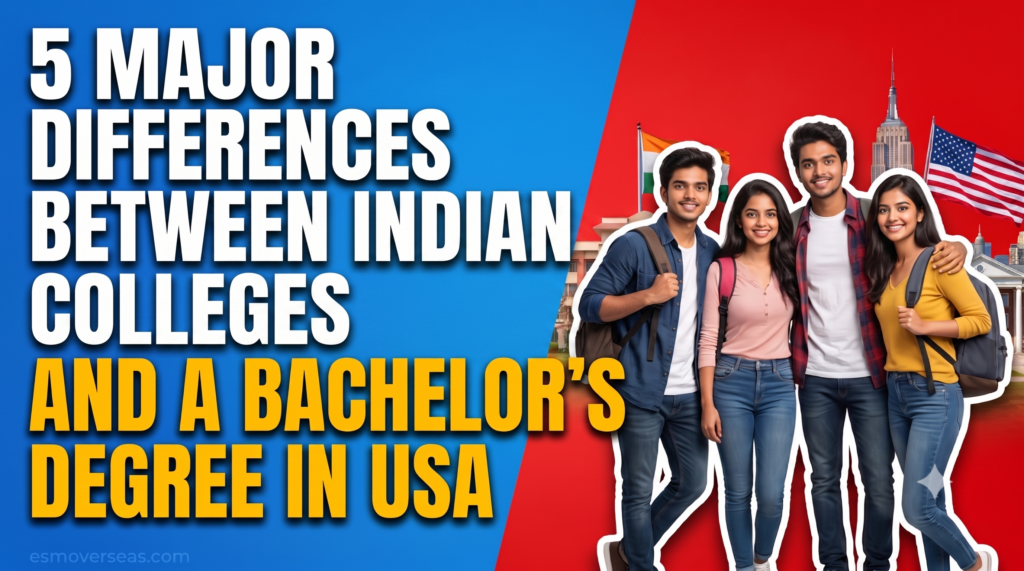
The biggest differences between Indian colleges and a Bachelor’s degree in USA are the admission process (holistic vs marks-only), curriculum flexibility (choose-as-you-go vs fixed streams), teaching style (interactive vs lecture-heavy), cost structure (higher fees but strong scholarships and on-campus work), and career outcomes (global exposure through Optional Practical Training). Together, these shape a very different four years for your child.
If you are a parent in Chandigarh, Mohali, Ludhiana, or anywhere in Punjab and Haryana sitting with your son or daughter, trying to decide between a local BCom or BTech and a Bachelor’s programme abroad, you are not alone. Every week, families walk into our Sector 35B office with the same question: “Sir, humein pata hai USA ki degree achi hoti hai, but kyun? What actually changes?” This article breaks it down honestly, point by point, with real numbers and real timelines, so you can make a decision with your eyes open rather than on hearsay from a neighbour or a relative.
1. Admission Process: Marks-Only vs Holistic Review
In most Indian colleges, admission is a straightforward numbers game. Your Class 12th percentage or your CUET/entrance exam score decides which college and course you get. There is very little room for a student who is average in Board exams but strong in extracurriculars, leadership, or a specific talent.
A Bachelor’s degree in USA works completely differently. Admissions committees look at a full profile:
- Academic transcripts (Class 10th and 12th marks, or ongoing 12th results)
- Standardized test scores (SAT or ACT — increasingly optional at many universities since 2024-25)
- English proficiency: IELTS, TOEFL, or Duolingo English Test
- Statement of Purpose or Common App Essay
- Letters of Recommendation (usually 2)
- Extracurricular activities, sports, volunteering, or a part-time job
In our experience handling 200+ applications every admission cycle at ESM Overseas, we have seen students with a 78% in Class 12th get into decent state universities in the USA simply because their essay and extracurricular profile were strong — something that would never happen in an Indian college admission system. On the flip side, we have also had to counsel toppers with 95%+ marks that a weak SOP or no extracurricular activity can genuinely hurt their chances at top-50 US universities.
Typical Application Timeline for Fall Intake
- 12–15 months before intake: Shortlist universities, start SAT/IELTS preparation
- 10–12 months before: Take IELTS/TOEFL and SAT (if required)
- 8–10 months before: Draft SOP, request recommendation letters
- 6–9 months before: Submit applications (most US deadlines fall between November and February for Fall intake)
- 4–6 months before: Receive admission decisions and scholarship offers
- 3–4 months before: Pay deposit, receive I-20, book visa slot
- 1–2 months before: Attend F-1 visa interview at the US Embassy/Consulate
This is quite different from Indian admissions, where the entire process from result declaration to college joining can take as little as 4–6 weeks. If you’re just starting to explore your options, our visa guidance page has a more detailed month-by-month planner.
2. Curriculum Structure: Fixed Stream vs Flexible Majors
This is possibly the difference that surprises Indian parents the most. In India, once you pick BCom, BTech, or BSc, your subjects are fixed for three or four years. Switching from Engineering to Economics halfway through is nearly impossible without starting over.
In the USA, most Bachelor’s programmes follow a “liberal arts” style structure for the first year or two, where students take general education courses across subjects before formally declaring a “major” (equivalent to your core specialization) at the end of Year 1 or Year 2. Many universities also allow a “minor” — a secondary area of study.
| Feature | Indian College (e.g., BCom, BTech) | Bachelor’s Degree in USA |
|---|---|---|
| When you choose your major | Before admission (locked in) | End of Year 1 or Year 2 (flexible) |
| Can you switch majors mid-course? | Very difficult, often requires re-admission | Common and usually straightforward |
| Elective subjects | Limited, mostly fixed by department | Extensive — arts, science, and business electives mixed freely |
| Typical duration | 3 years (BA/BCom/BSc), 4 years (BTech) | 4 years standard |
| Double major/minor option | Not commonly available | Widely available at most universities |
ESM Overseas’ visa experts often tell families that this flexibility is a double-edged sword — it’s wonderful for a genuinely undecided student, but it can also mean a longer time to graduate if the student keeps switching interests without guidance. We usually recommend students walk in with at least a broad direction (STEM, business, or humanities) even if the exact major isn’t fixed.
3. Teaching Style and Classroom Environment
Indian classrooms, especially in large government and semi-private colleges, are still largely lecture-based, with 60–120 students in one hall, minimal discussion, and heavy reliance on textbooks and rote learning before exams.
US undergraduate classrooms — particularly outside the first-year “intro” lecture halls — tend to be smaller, more discussion-based, and continuously assessed. A typical US course does not depend on one final exam; instead, grades are built from:
- Weekly quizzes or homework (15–20%)
- Class participation and attendance (10–15%)
- Mid-term exams (20–25%)
- Group projects or presentations (10–20%)
- Final exam or capstone project (25–30%)
This continuous assessment model rewards consistency over the year rather than last-minute exam preparation, which is the opposite of how most Indian college exams work. Students who are used to “exam mein sab kar lenge” (we’ll manage everything at exam time) often need 1–2 semesters to adjust to this rhythm. This is something we flag clearly during our pre-departure briefings at our Chandigarh office, because it genuinely affects a student’s first-year GPA.
4. Cost Structure: Fees, Scholarships, and On-Campus Work
This is the section most parents want to skip to, and rightly so — cost is often the deciding factor. Let’s look at real, current numbers.
| Cost Component | Indian Private College (Annual) | US Public University (Annual, out-of-state) |
|---|---|---|
| Tuition Fee | ₹1,00,000 – ₹4,00,000 | USD 20,000 – 35,000 (approx. ₹19,20,000 – ₹33,60,000) |
| Hostel/Accommodation | ₹60,000 – ₹1,20,000 | USD 10,000 – 14,000 (approx. ₹9,60,000 – ₹13,44,000) |
| Food | Often included in hostel fee | USD 3,000 – 5,000 (approx. ₹2,88,000 – ₹4,80,000) if not on meal plan |
| Health Insurance | Usually not mandatory | USD 1,500 – 2,500 (approx. ₹1,44,000 – ₹2,40,000), mandatory at most universities |
| Total Approx. Annual Cost | ₹2,00,000 – ₹6,00,000 | ₹33,00,000 – ₹54,00,000 |
(Currency conversion approximated at USD 1 = ₹96 as of July 2026; actual figures will vary by university and exchange rate on the day of payment.)
Yes, the gap is significant — often 6 to 10 times higher for a US degree. But there are three factors that regularly change this equation, which is why we always ask families to look beyond the sticker price:
- Merit scholarships: Many US universities offer USD 5,000–20,000 per year in merit aid to strong international applicants, sometimes covering 30–50% of tuition.
- On-campus work: F-1 visa students can legally work up to 20 hours/week on campus during the semester, earning roughly USD 10–15/hour, which can cover a meaningful part of living expenses.
- Optional Practical Training (OPT): After graduation, students get 12 months (up to 36 months for STEM majors) of work authorization in the USA, often leading to a salary of USD 55,000–75,000/year — a return on investment Indian degrees rarely match in the first two years post-graduation.
ESM Overseas’ visa experts always run a “true cost after scholarship” calculation for every student before they finalize a university, because two universities with similar tuition can end up costing very differently once aid is factored in.
5. Visa Process and Post-Study Work Rights
An Indian college obviously requires no visa. A Bachelor’s degree in USA requires an F-1 student visa, and this is where families often feel the most anxious — understandably so, since it’s an unfamiliar government process with real deadlines.
Here is what the F-1 visa journey typically looks like, based on our day-to-day casework:
- Receive I-20 from your admitted university after fee/deposit payment
- Pay the SEVIS I-901 fee (currently USD 350) online
- Complete the DS-160 form and pay the visa application fee (currently USD 185, approx. ₹17,760)
- Schedule your visa interview at the nearest US Consulate (Chandigarh students typically go to the New Delhi Consulate)
- Prepare documents: I-20, financial proof, academic records, SOP, and interview practice
- Attend the interview — decisions are often given the same day
- Visa stamping usually takes 3–7 working days after approval, though this can extend during peak season (June–August)
In our experience handling 200+ applications, visa interview wait times at the New Delhi Consulate can stretch to 3–5 weeks during peak season, so we advise students to book their slot the moment the I-20 arrives — not after finishing every other document. Families visiting our SCO 375-376, Sector 35B, Chandigarh office get a full mock-interview session as part of our visa preparation support, which has helped many first-generation applicants walk in with real confidence rather than memorized answers.
The other major difference: an Indian degree gives you the right to work in India immediately. A US Bachelor’s degree gives graduates access to OPT (and STEM OPT extension), which many students use as a stepping stone toward an H-1B work visa or further studies. For more on how student and work visas connect, see our visa guidance resources.
Which One Is Actually “Better”? An Honest Take
We won’t tell you a US Bachelor’s is automatically better — that would be misleading. If your child is clear about a specific career (say, a government job requiring an Indian degree, or a family business), a strong Indian college close to home may be the smarter, more cost-effective choice. But if your child wants global exposure, is open to working abroad, and your family can plan finances (including education loans) over 3-4 years, a Bachelor’s degree in USA opens doors that are hard to replicate from an Indian campus alone — better research exposure, stronger industry connections, and a degree that is recognized worldwide.
The honest answer depends on your child’s goals, your budget, and how prepared they are for an independent, self-directed learning environment. This is exactly the kind of decision we sit down and map out, one family at a time, at our Chandigarh office.
Frequently Asked Questions
1. Is a Bachelor’s degree from the USA valid and recognized in India?
Yes. US Bachelor’s degrees from accredited universities are recognized by Indian authorities (including AIU equivalence where required) for further studies and most private-sector employment in India.
2. How many years does a Bachelor’s degree take in the USA compared to India?
A US Bachelor’s degree is almost always 4 years, regardless of major. In India, it varies — 3 years for BA/BCom/BSc, and 4 years for BTech/BE.
3. Can Indian students get scholarships for a Bachelor’s degree in the USA?
Yes, many public and private US universities offer merit-based scholarships to international students, often ranging from USD 5,000 to 20,000 per year based on academic and extracurricular profile.
4. Do I need SAT scores to apply to US universities in 2026?
It depends on the university. A growing number of US universities have gone “test-optional,” but competitive programmes and scholarship applications often still consider SAT/ACT scores favourably. We recommend checking each university’s current policy individually.
5. How much does an F-1 student visa cost in 2026?
The main costs are the SEVIS I-901 fee (USD 350) and the DS-160 visa application fee (USD 185), totalling approximately ₹51,360, excluding any consultancy or documentation support.
6. Can students work while studying on a Bachelor’s degree in the USA?
Yes, F-1 visa holders can work up to 20 hours per week on campus during the semester and full-time during official breaks, subject to university and visa rules.
7. What is OPT and how does it help after graduation?
Optional Practical Training (OPT) allows F-1 graduates to work in the USA for 12 months after their degree, extendable to 36 months for STEM majors, offering valuable US work experience before returning to India or pursuing further options.
8. Is it harder to get into a good US university than a good Indian college?
It’s different rather than strictly harder. Indian admissions are marks-driven, while US admissions weigh essays, recommendations, and extracurriculars alongside academics — so a student weak in one area can often compensate with strength in another.
Let’s Talk — No Pressure, Just Clarity
Choosing between an Indian college and a Bachelor’s degree in USA is a big decision for any family, and it deserves an honest, unhurried conversation rather than a sales pitch. If you’d like to talk through your child’s specific profile, budget, and options, we offer a free 15-minute consultation with ESM Overseas’ visa experts — no obligation, just clear answers.
Call or WhatsApp us at +91-7087217801
Visit us at SCO 375-376, Sector 35B, Chandigarh
Or reach out anytime through our Contact Us page
We’ve walked with over 200 families through this exact decision — we’d be glad to walk with yours too.