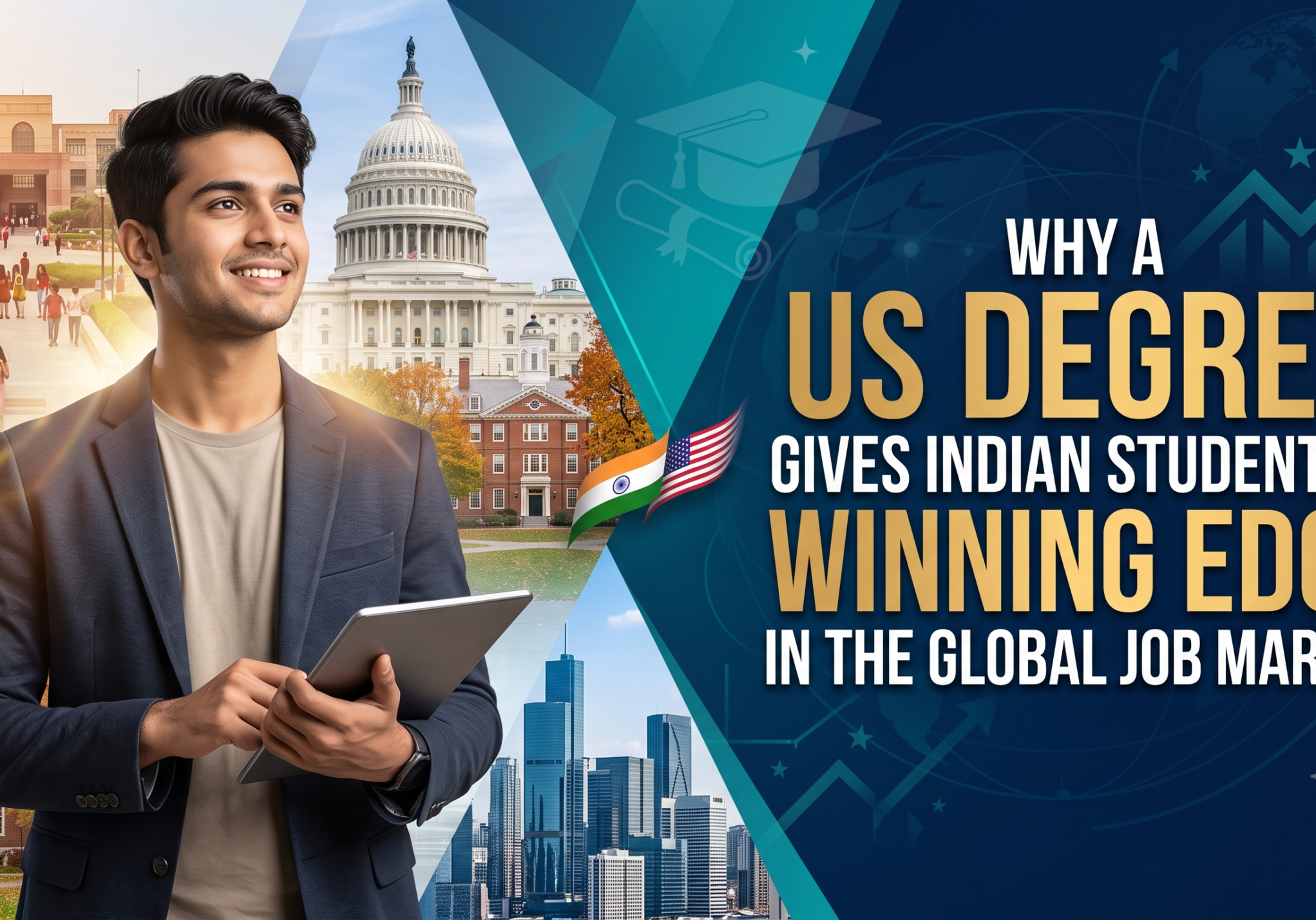
Why Does a US Degree Give Indian Students a Global Career Advantage?
A US degree gives Indian students a global edge because it combines globally recognised universities, hands-on work experience through OPT and STEM OPT, direct access to multinational recruiters, and a vast international alumni network — all before a student even applies for their first job. Employers in over 190 countries recognise US degrees, which is why graduates often have more career options, not just in the US, but worldwide.
Every year, families in Punjab, Haryana, and Chandigarh ask us the same honest question: “Is a US degree really worth the cost, or is it just a status symbol?” It’s a fair question, and it deserves a fact-based answer, not a sales pitch. In our experience counselling over 500 students on university and program selection at ESM Overseas, the students who benefit most from a US degree are the ones who understand exactly how it translates into career value — not just in America, but anywhere in the world they choose to work.
This article breaks down, with real numbers, exactly why a US degree continues to open doors that other qualifications often don’t.
The Real Numbers: How a US Degree Compares Globally
Let’s start with what actually matters to most families: post-study work rights and earning potential. Here’s how a US degree stacks up against other popular study destinations on the two factors that influence career outcomes the most.
| Country | Post-Study Work Visa Duration | Typical Starting Salary Range (Tech/Engineering Roles) |
| USA (OPT + STEM OPT) | Up to 3 years (12 months OPT + 24 months STEM extension) | $70,000–$95,000 (₹66,50,000–₹90,25,000) |
| Canada (PGWP) | Up to 3 years, based on program length | CAD 55,000–75,000 / ~$40,000–55,000 (₹38,00,000–₹52,25,000) |
| UK (Graduate Route) | 2 years (3 years for PhD) | £28,000–38,000 / ~$35,000–48,000 (₹33,25,000–₹45,60,000) |
| Australia (Temporary Graduate visa) | 2–4 years, depending on qualification level | AUD 60,000–75,000 / ~$40,000–50,000 (₹38,00,000–₹47,50,000) |
Figures above are approximate industry ranges for 2026 and vary significantly by role, city, and employer; all INR conversions use ~₹95 per US dollar (September 2026). What stands out is that the US consistently offers both a longer window to gain work experience and, in high-demand technical fields, some of the highest average starting compensation among major study destinations.
Five Ways a US Degree Sets Indian Students Apart Globally
1. Globally Recognised Universities and Rankings
The United States is home to more top-100 globally ranked universities than any other country, across nearly every major discipline — engineering, business, computer science, healthcare, and the sciences. This matters practically: recruiters in Singapore, Dubai, London, and Bengaluru alike recognise degrees from well-known US institutions instantly, which shortens the trust-building process in a job interview.
2. Real Work Experience Through OPT and STEM OPT
This is the single biggest structural advantage of a US degree. Optional Practical Training (OPT) allows F-1 graduates to work in the US for 12 months in a role related to their field, with no employer sponsorship required to begin working. Graduates in STEM fields — a large share of Indian students — can extend this by another 24 months, giving up to 3 full years of US work experience before ever needing a work visa. Compare that to India, where fresh graduates typically compete for a smaller pool of comparable roles at a fraction of the starting salary; the ability to build 1–3 years of US-based, resume-defining experience is difficult to replicate anywhere else.
3. Direct Access to Global Recruiters
Most large US universities run career centres with direct pipelines into Fortune 500 companies, top consulting firms, and Silicon Valley tech employers — many of which actively run internship and full-time hiring programs specifically designed for international students on F-1 status. A single successful internship at a recognisable US company often becomes the strongest line on a graduate’s resume for years afterward, wherever they eventually choose to work.
4. Research Funding and Industry-Linked Innovation
US universities invest heavily in research infrastructure, and many programs are directly linked to industry partners, giving students access to applied projects, patents, and publications that are harder to access at the same scale elsewhere. For students aiming at R&D-heavy careers — semiconductors, AI, biotechnology, robotics — this exposure is often what separates a good resume from a exceptional one.
5. A Truly Global Alumni Network
US university alumni networks span nearly every major global city and industry. For Indian students specifically, this often means access to a ready-made professional community — Indian-origin alumni working at leading firms worldwide who are often willing to refer, mentor, or interview fellow graduates from their alma mater. In our experience, this informal network frequently matters as much as the formal career office in landing that first role.
What a US Degree Actually Costs vs What It Returns
No conversation about value is honest without discussing cost. Here is a realistic breakdown of a typical US Master’s program cost against realistic early-career earnings, so families can make an informed, not emotional, decision.
| Item | Amount (USD) | Approx. Amount (INR) |
| Tuition (STEM Master’s, per year) | $30,000–$60,000 | ₹28,50,000–₹57,00,000 |
| Living expenses (per year, most cities) | $12,000–$20,000 | ₹11,40,000–₹19,00,000 |
| Typical total program cost (2-year Master’s) | $65,000–$130,000 | ₹61,75,000–₹1,23,50,000 |
| Average STEM graduate starting salary (US, per year) | $103,580 | ₹98,40,100 |
| Software engineer starting salary (US, per year) | ~$131,450 | ₹1,24,87,750 |
Salary figures are drawn from US Bureau of Labor Statistics 2024 occupational data, the most recent verified benchmark available; actual offers vary by employer, city, and specialisation. What this comparison shows is that for many STEM graduates, a single year of US-based earnings can approach or exceed the total cost of the entire program — which is a very different picture from looking at the sticker price of tuition alone. ESM Overseas’ study abroad counsellors always recommend evaluating cost against realistic first-year earning potential in your specific field, not the headline tuition number.
Step-by-Step: How to Maximise Your US Degree’s Career Value
A US degree creates the opportunity — but students who plan deliberately get noticeably better outcomes than those who don’t. Here’s the approach we walk students through at our Chandigarh office.
- Choose your program based on career outcomes, not just university name. A slightly lower-ranked university with strong placement data in your specific field often beats a famous name with weak outcomes in that discipline.
- Prioritise STEM-designated programs where possible. The extra 24 months of STEM OPT work authorisation is one of the most valuable, underused advantages available to Indian students.
- Start building your resume from semester one. Join relevant student clubs, research groups, or teaching assistant roles early — recruiters notice sustained involvement, not last-minute activity.
- Apply for internships aggressively in your first year. Many strong full-time offers originate from a summer internship; leaving this until the final semester significantly narrows your options.
- Use the university career centre and alumni network actively. Most students underuse both — a short alumni coffee chat often leads further than dozens of cold applications.
- Plan your OPT timeline in advance. File your OPT application (Form I-765) within the window of 90 days before to 60 days after graduation, since delays can create employment gaps.
- If eligible for the H-1B lottery, register every year you’re eligible. Selection is random, so consistent participation over your OPT window meaningfully improves your cumulative odds.
- Keep your options open globally. A strong US degree and work history travel well — many graduates ultimately build highly successful careers back in India, in the Gulf, in Singapore, or in Europe, using their US credential as the differentiator.
The Work Visa Pathway After Graduation: OPT, STEM OPT, and H-1B
Understanding what actually happens after graduation removes a lot of the anxiety families feel about “what if I can’t stay and work.” Here’s the pathway, stage by stage, as it stands in 2026.
| Stage | Duration | Key Requirement (2026) |
| Post-completion OPT | 12 months | Form I-765 filed with USCIS; filing fee $1,780 |
| STEM OPT extension | +24 months (36 months total) | Degree must be on the STEM-designated list; employer must be E-Verify enrolled |
| H-1B cap lottery | 3-year visa, renewable once | 85,000 annual cap (65,000 regular + 20,000 US master’s); employer-sponsored registration |
ESM Overseas’ visa experts always explain this pathway honestly: the H-1B is a lottery, not a guarantee. In the FY2026 cycle, roughly 344,000 eligible registrations competed for the 85,000 available slots — meaning a selection probability of around 1 in 4 per registration cycle. Because eligible candidates can register in multiple consecutive years during their OPT window, the realistic cumulative odds over 2–3 years are meaningfully better than a single-year snapshot suggests — but no consultancy can or should promise a guaranteed outcome. What a strong US degree does guarantee is 1 to 3 years of legally authorised US work experience regardless of the H-1B result, which by itself is a career asset worth having.
Which US Degrees Give the Strongest Job Market Edge?
| Field | STEM-Designated? | Typical Starting Salary (USD) |
| Computer Science / Data Science | Yes | $90,000–$131,000 |
| Electrical / Mechanical Engineering | Yes | $75,000–$105,000 |
| Business Analytics / Finance (quant-heavy) | Often yes (varies by program) | $80,000–$110,000 |
| MBA (top-ranked programs) | No (unless STEM-MBA track) | $110,000–$150,000 |
| Humanities / General Social Sciences | No | $45,000–$65,000 |
The pattern here is clear and worth discussing honestly with your counsellor before you apply: STEM-designated programs consistently offer both higher starting salaries and a longer post-study work window. This doesn’t mean non-STEM degrees have no value — but it does mean the field you choose has a direct, measurable impact on your career runway in the US and, by extension, on your global career story.
Beyond the Paycheck: Soft Skills That Travel Well
Salary numbers tell only part of the story. In our conversations with students who return to work in India or move on to a third country after a few years in the US, the same set of advantages comes up again and again — and these matter just as much for long-term career growth as the starting pay cheque.
- Independent problem-solving. Managing coursework, finances, and daily life in a new country builds a level of self-reliance that employers consistently notice in interviews and on the job.
- Cross-cultural communication. Working in project teams with classmates and colleagues from dozens of countries builds a comfort with diverse working styles that is hard to replicate in a single-culture workplace.
- Comfort with ambiguity and fast decision-making. US work culture, particularly in tech and consulting, rewards employees who can move fast with incomplete information — a habit students pick up quickly during internships and OPT roles.
- A genuinely global professional identity. Graduates who’ve studied and worked in the US often find it easier to later work in Dubai, Singapore, or London, because they’ve already proven they can adapt to an unfamiliar system once.
These are the qualities that, in our experience, separate graduates who plateau in their first role from those who get promoted quickly or make a confident international move a few years in.
Common Concerns Parents Raise — Addressed Honestly
- “Is it worth the loan we’ll need to take?” For STEM fields with strong placement records, yes, in most cases — a single year’s US salary can approach the total program cost. For lower-ROI fields, we recommend a frank conversation about numbers before committing.
- “What if our child doesn’t get a job in the US?” A US degree and even a partial OPT work history remain highly valued by employers in India, the Gulf, and Southeast Asia — the investment isn’t wasted even without a US job outcome.
- “Is the visa process too risky to plan around?” The F-1 student visa and OPT work authorisation are separate from the H-1B lottery; students can complete their degree and work for up to 3 years regardless of H-1B outcomes.
- “How do we know which university is actually good for placements?” This is exactly where personalised guidance matters more than rankings alone — program-level outcomes vary significantly even within the same university.
How ESM Overseas Helps
Choosing a US program isn’t just about admission — it’s about picking the right field, university, and specialisation for the career outcome you actually want. At ESM Overseas, we help students compare programs on real outcome data, not just brand names, and we’re upfront about where the numbers genuinely support the investment and where they don’t. You can learn more about our approach on our USA study page, or review the visa process in detail on our visa guidance page.
Frequently Asked Questions
Does a US degree really help with jobs outside the US?
Yes. US degrees are recognised in over 190 countries, and combined with any US work experience gained through OPT, graduates are often strongly preferred by multinational employers in India, the Gulf, Europe, and Southeast Asia.
What is OPT and how long does it last?
Optional Practical Training (OPT) allows F-1 graduates to work in the US for 12 months in a role related to their degree. STEM graduates can extend this by 24 additional months, for a total of up to 36 months of work authorisation.
Is a US degree only worth it for STEM fields?
STEM fields generally offer the strongest financial ROI due to higher salaries and the STEM OPT extension, but strong business, finance, and analytics programs can also offer good outcomes — the key is choosing a program with a genuinely strong placement record in your specific field.
What are the chances of getting an H-1B visa after OPT?
In the FY2026 cycle, roughly 1 in 4 eligible registrations were selected in the lottery. Because graduates can register across multiple years during their OPT window, cumulative odds over 2–3 years are generally better than a single year’s probability, though selection is never guaranteed.
How much does a US Master’s degree typically cost in 2026?
A 2-year STEM Master’s program typically costs between $65,000 and $130,000 total (approximately ₹61,75,000 to ₹1,23,50,000), including tuition and living expenses, depending on the university and city.
Can a student work in the US immediately after their degree without H-1B?
Yes. OPT and STEM OPT work authorisation do not require H-1B sponsorship, so most F-1 graduates can begin working in the US immediately after graduation without waiting for a visa lottery outcome.
How does ESM Overseas help students choose the right US program?
We compare universities and programs on actual placement outcomes, alumni network strength, and field-specific ROI data — not rankings alone — and help match this against each student’s academic background, budget, and career goals.
Is it better to study in the US or Canada/UK/Australia for career outcomes?
It depends on the field and priorities. The US generally offers the longest post-study work window (up to 3 years with STEM OPT) and the highest salaries in technical fields, while Canada, the UK, and Australia offer comparatively simpler and faster paths to permanent residency in some cases. The right choice depends on whether career earnings or long-term settlement is the higher priority for your family.
Let’s Find the Right Program for Your Goals
The right US degree can be one of the strongest career investments a family makes — but only when the university, field, and financial plan are chosen deliberately. We’d be glad to walk through your specific profile and give you an honest read on the outcomes to expect.
Book a free 15-minute consultation with our team — no pressure, no obligation. Call or WhatsApp us at +91-7087217801, or visit us at our Chandigarh office:
ESM Overseas
SCO 375-376, Sector 35B, Chandigarh
You can also reach out through our contact us page or explore more on our USA study page before you get started. We’re here to help you make this decision with clarity, not pressure.