How Can Indian Students Fund a US Education?
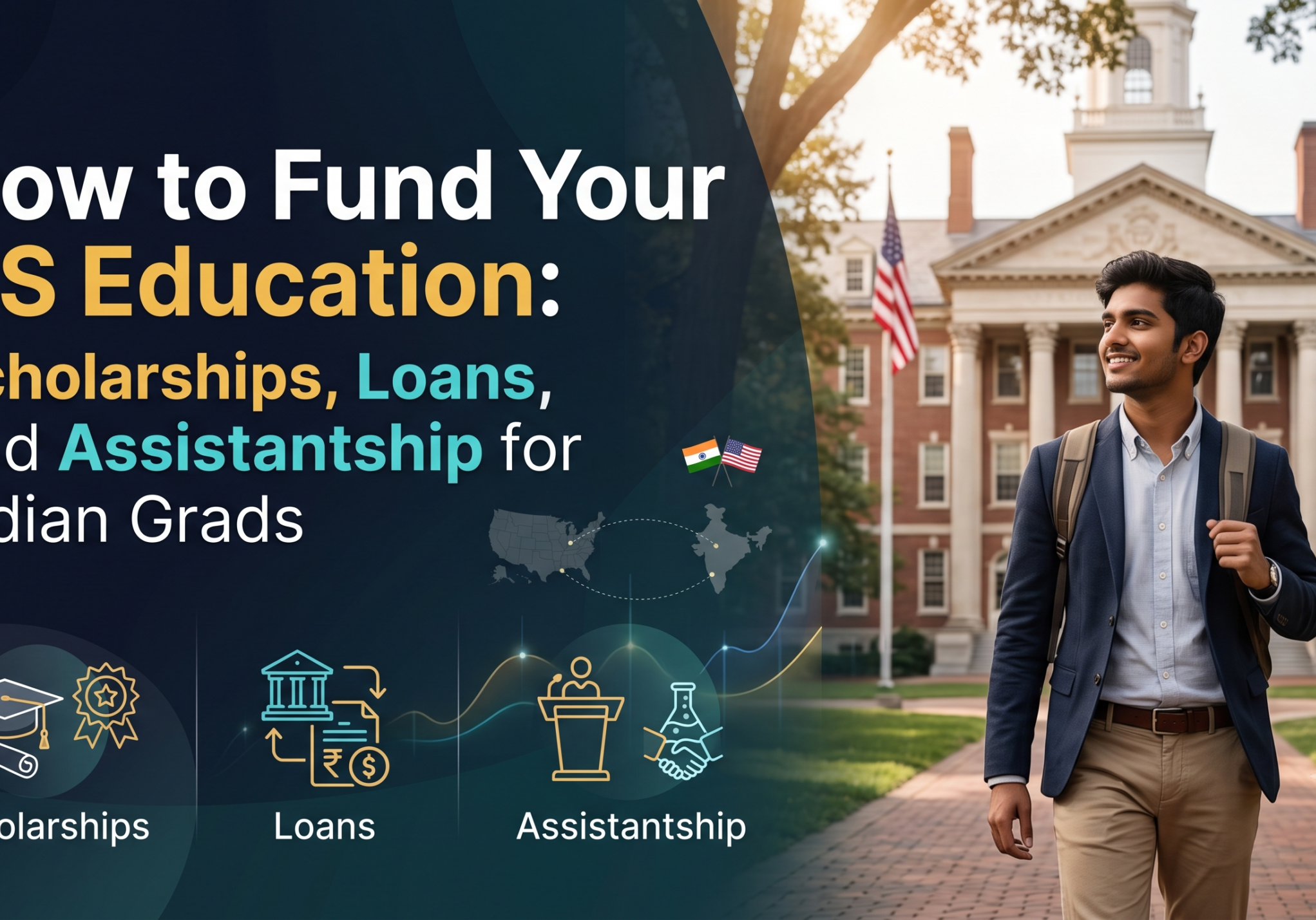
Most Indian students fund a US education through a combination of three sources: an education loan (covering the bulk of the cost), a merit or need-based scholarship (reducing the amount borrowed), and a graduate assistantship once on campus (offsetting living costs and, often, tuition itself). Very few students rely on just one source — a well-planned mix is what actually makes the numbers work.
Every family we sit down with at our Chandigarh office asks a version of the same question: “We have the admit — now how do we actually pay for this?” It’s the right question to ask before, not after, accepting an offer. In our experience guiding 300+ families through this exact planning process, the students who fund their education smoothly are the ones who map out all three sources together, months before departure — not the ones scrambling to arrange money in the final weeks.
This article walks through exactly how scholarships, loans, and assistantships work in 2026, with real numbers, so you can build a funding plan that doesn’t leave you stressed six months in.
The Real Cost You’re Funding: A Quick Recap
Before comparing funding options, it helps to know the actual number you’re solving for. A typical 2-year STEM Master’s program in the US costs between $65,000 and $130,000 total (tuition plus living expenses), depending on the university and city — approximately ₹61,75,000 to ₹1,23,50,000 at the current exchange rate of ~₹95 per US dollar (September 2026). That total is what your combination of loan, scholarship, and assistantship income needs to cover.
Scholarships Indian Students Can Actually Win
Scholarships rarely cover the entire cost on their own, but even a partial award meaningfully reduces the loan burden — and some of the most generous options are specifically open to Indian applicants. Here are the ones ESM Overseas’ education finance counsellors most often recommend students research early.
| Scholarship | Typical Award | Key Eligibility Note |
| Fulbright-Nehru Master’s Fellowship | Fully funded: tuition, living stipend, airfare, health cover (~$50,000–$80,000/year, ₹47,50,000–₹76,00,000) | Requires 3+ years of professional work experience; open mainly to public policy, social sciences, and select professional fields — not open to most engineering/CS applicants |
| J. N. Tata Endowment | Interest-free loan scholarship up to ₹20 lakh, plus a non-repayable gift grant up to ₹7.5 lakh for top candidates, plus a travel grant up to ₹85,000 | Open to all postgraduate and doctoral disciplines; loan repayable over 7 years after course completion |
| Inlaks Shivdasani Foundation Scholarship | Up to $120,000 total (~₹1,14,00,000), covering tuition, living costs, travel, and health allowance | Excludes engineering, computer science, MBA/management, and medicine — mainly for humanities, social sciences, law, fine arts, and pure sciences |
| University-specific merit scholarships | Typically $5,000–$25,000/year (₹4,75,000–₹23,75,000), varies widely by university | Usually awarded automatically on admission based on academic profile; some require a separate scholarship application |
A word of honest advice here: the two most generous named scholarships above — Inlaks and Fulbright-Nehru — explicitly exclude or heavily restrict engineering, computer science, and MBA applicants, which happen to be the most common fields for students from our region. Don’t build your entire funding plan around winning one of these; treat them as a bonus to apply for, while planning your core funding through loans and university merit aid.
Education Loans: Comparing Your Options in 2026
For most Indian families, the education loan is the backbone of the funding plan. Rates and terms vary meaningfully between public sector banks, private banks, and international lenders, so it’s worth comparing more than just the headline interest rate.
| Lender | Interest Rate (2026) | Collateral-Free Limit | Max Loan Amount |
| SBI Global Ed-Vantage | 8.90%–11.15% (floating) | Up to ₹50 lakh (premier institutes only) | Up to ₹3 crore with collateral |
| PNB Udaan | 8.10%–11.00% | Up to ₹7.5 lakh | No fixed upper limit |
| HDFC Credila | 9.75%–13.00% | Case-by-case, up to ₹80 lakh | Up to 100% of educational expenses |
| Avanse Financial (NBFC) | 10.25% onwards | Up to ₹1.25 crore | Up to ₹1.25 crore |
| MPOWER Financing (international, no Indian collateral) | 9.99% onwards | 100% (US-dollar loan) | Up to $100,000 (~₹95,00,000) |
| Prodigy Finance (international, no Indian collateral) | 10.69% onwards | 100% (US-dollar loan) | Based on program and university |
Rates shown are floating, indicative starting rates as of 2026 and vary by applicant profile, university, and co-applicant income; always confirm current rates directly with the lender before applying. As a general pattern, public sector banks like SBI and PNB offer the lowest interest rates but usually require collateral above ₹7.5 lakh, while private banks, NBFCs, and international lenders like MPOWER and Prodigy Finance charge higher rates but skip the collateral requirement entirely — a meaningful advantage for families without property to pledge.
Graduate Assistantships: Earn While You Study
This is the funding source most Indian students underestimate before arriving in the US — and one of the most valuable once they’re there. A Teaching Assistantship (TA), Research Assistantship (RA), or Graduate Assistantship (GA) typically requires about 20 hours of work per week supporting a professor’s coursework, lab, or research project, in exchange for a monthly stipend and a full or partial tuition waiver.
| Assistantship Type | Typical Monthly Stipend | Tuition Benefit |
| Teaching Assistant (TA) | $1,800–$2,800 (₹1,71,000–₹2,66,000) | Full or partial tuition waiver, often including in-state tuition rate at public universities |
| Research Assistant (RA) | $1,800–$2,800 (₹1,71,000–₹2,66,000) | Usually full tuition waiver, tied to a specific funded research project |
| Graduate Assistant (GA) — administrative/departmental roles | $1,150–$2,000 (₹1,09,250–₹1,90,000) | Partial to full tuition waiver, depending on department and hours |
Over a 10-month academic year, this stipend alone can add up to $18,000–$28,000 (₹17,10,000–₹26,60,000) — often enough to cover most or all of a student’s living expenses, on top of the tuition savings. ESM Overseas’ education finance counsellors always recommend that STEM-bound students ask directly about assistantship availability during university shortlisting, since offer rates vary significantly between departments and are rarely mentioned upfront in admission brochures. A TOEFL or IELTS speaking score requirement (commonly TOEFL Speaking 26+ or IELTS Speaking 8.0) usually applies for Teaching Assistant roles specifically, since TAs interact directly with undergraduate students.
Step-by-Step: Building Your Funding Plan
- Calculate your real total cost first. Add tuition, living expenses, health insurance, and one-time costs (visa fees, flights, setup costs) for the full program duration, not just year one.
- Apply for university merit scholarships at the time of admission. Many are auto-considered, but some require a separate form — check each university’s financial aid page directly.
- Research and apply to external scholarships 6–9 months before departure. Fulbright-Nehru, JN Tata, and similar programs have early deadlines (often January–July for the following intake) and multi-stage selection processes.
- Ask every shortlisted university about assistantship availability for your specific department. Email the graduate coordinator directly — this single question can change your funding plan significantly.
- Get education loan pre-approval before finalising your university choice. This tells you your real borrowing capacity and interest rate before you commit.
- Compare at least 3 lenders — one public bank, one private/NBFC, one international option. A 1–2% rate difference on a ₹50 lakh loan adds up to several lakh rupees over the loan tenure.
- Build a realistic month-by-month budget once you know your funding mix. Include a buffer for currency fluctuation and unplanned expenses in the first semester.
- Keep all loan and scholarship documentation organised — you’ll need proof of funding for your visa application, and lenders/scholarship bodies often require proof of enrolment and progress updates each year.
Smart Ways to Combine These Three Sources
Here’s a realistic example of how these three sources typically work together for a $90,000 (~₹85,50,000) two-year program — the kind of blended plan ESM Overseas’ education finance counsellors help families build.
| Funding Source | Approx. Contribution | Approx. Amount (USD / INR) |
| Education loan | ~55% | $49,500 / ₹47,02,500 |
| Graduate assistantship (stipend + tuition waiver, over 2 years) | ~30% | $27,000 / ₹25,65,000 |
| University merit scholarship / family savings | ~15% | $13,500 / ₹12,82,500 |
This is only an illustrative split — the right mix depends on your field, university, and whether an assistantship offer materialises after arrival, which is why it’s worth planning your loan amount with some flexibility rather than borrowing the absolute maximum on day one.
Tax Benefits and Money-Saving Tips for Families
- Section 80E interest deduction: The entire interest paid on an education loan is deductible from taxable income, with no upper cap, for up to 8 years from the start of repayment — under the old tax regime. Over a typical loan tenure, this can save a family roughly ₹5–8 lakh in tax outgo.
- TCS on foreign remittances: Remittances funded through a specified financial institution’s education loan currently attract nil Tax Collected at Source (TCS), while self-funded transfers above the applicable threshold attract TCS at the prevailing rate. These rules are revised periodically in the Union Budget, so ESM Overseas’ visa experts always recommend confirming the current threshold and rate with your bank before making a large transfer.
- Female student interest concessions: Most public sector banks offer a 0.25%–0.50% interest rate concession for female applicants — worth asking about explicitly, as it isn’t always advertised.
- Insurance-linked rate concessions: Several public banks offer an additional 0.25%–0.50% rate reduction if the loan is bundled with a linked insurance policy — compare the insurance cost against the interest saved before opting in.
Common Funding Mistakes We See in Punjab and Haryana Families
- Applying for a loan only after the visa interview is scheduled. Loan sanction letters take time — starting the process 4–6 months in advance avoids last-minute pressure and strengthens your visa financial documentation.
- Choosing the lender with the lowest advertised rate without checking collateral terms. A slightly higher rate with no collateral requirement is often the better real-world choice for families without property to pledge.
- Ignoring assistantship potential when shortlisting universities. Two universities with similar rankings can have very different assistantship funding rates for international students in the same department.
- Not applying for scholarships because “we probably won’t get it.” Even partial scholarships reduce loan interest significantly over time, and the application cost is usually just time, not money.
- Underestimating first-semester costs before any stipend income begins. Assistantship stipends usually start only once the semester begins — budget for the first 4–6 weeks separately.
How ESM Overseas Helps
Funding a US education involves coordinating three moving pieces — scholarships, loans, and on-campus income — and getting the sequencing right matters as much as getting the numbers right. At ESM Overseas, we help families map out a realistic funding plan before committing to a university, compare loan offers across multiple lenders, and identify universities and departments with genuinely strong assistantship track records for international students. Learn more on our USA study page, or review the visa financial documentation requirements on our visa guidance page.
Other Ways to Reduce Your Costs While Studying
Beyond the three main funding sources, a few additional options can meaningfully lower your out-of-pocket costs once you’re on campus. These won’t replace your core funding plan, but they add up over a full program.
- On-campus part-time work. F-1 students can work up to 20 hours per week on campus during the semester (full-time during official breaks), in roles like library assistance, campus dining, or administrative support — typically paying $12–$20 per hour (₹1,140–₹1,900/hour), enough to cover groceries and incidentals.
- Curricular Practical Training (CPT). Many programs allow paid internships during the course of study itself, before graduation, through CPT authorisation — a useful way to earn while gaining relevant experience, provided it’s approved by your Designated School Official in advance.
- In-state tuition through assistantships at public universities. At many public state universities, holding a qualifying assistantship reclassifies you for in-state tuition rates, which can cut the sticker-price tuition by 50–70% — a detail worth confirming directly with the graduate school, since it isn’t always advertised clearly.
- Departmental and college-specific scholarships. Beyond the university-wide merit scholarship, many individual departments run their own smaller scholarships or fee waivers specifically for international or high-performing students — these are worth asking about directly once you’ve been admitted.
Frequently Asked Questions
What is the best way to fund a US Master’s degree from India?
Most students use a combination of an education loan, a partial scholarship, and a graduate assistantship once on campus. Relying on a single source is uncommon; a blended plan is generally more realistic and reduces total interest paid.
Do I need collateral for an education loan to study in the US?
It depends on the lender and amount. Public sector banks typically require collateral for loans above ₹7.5 lakh, though some offer collateral-free limits up to ₹50 lakh for premier institutes. International lenders like MPOWER and Prodigy Finance offer collateral-free loans without needing Indian assets.
Can international students get a graduate assistantship in the US?
Yes. Many US universities offer Teaching, Research, and Graduate Assistantships to international F-1 students, typically for about 20 hours of work per week, in exchange for a monthly stipend and a full or partial tuition waiver.
Are Fulbright and Inlaks scholarships open to engineering and CS students?
Generally no. Fulbright-Nehru Master’s Fellowships are mainly open to public policy, social sciences, and select professional fields, and the Inlaks Shivdasani Foundation Scholarship explicitly excludes engineering, computer science, MBA, and medicine. Students in these fields should focus on university merit scholarships and assistantships instead.
How much can I save through the Section 80E tax deduction?
The entire interest paid on an education loan is deductible with no upper limit, for up to 8 years, under the old tax regime. Over a typical loan tenure, families commonly save approximately ₹5–8 lakh in total tax outgo, depending on the loan size and applicable tax slab.
Is it better to apply for a loan from a public bank or a private lender?
Public sector banks generally offer lower interest rates but usually require collateral above ₹7.5 lakh and slower processing (4–8 weeks). Private lenders and NBFCs charge higher rates but process faster and often skip the collateral requirement — the right choice depends on your family’s asset position and timeline.
When should I start applying for scholarships and loans?
Ideally 6–9 months before your intended intake. Major scholarships like Fulbright-Nehru and JN Tata have early deadlines and multi-stage selection processes, and loan sanction letters typically take several weeks to a few months to finalise.
Can ESM Overseas help me compare loan offers from different banks?
Yes. We help families compare offers across public banks, private lenders, and international options, and identify universities with strong assistantship funding for their specific field. Reach out through our contact us page to discuss your funding plan.
Let’s Build Your Funding Plan Together
The right combination of loan, scholarship, and assistantship can significantly change what your US education actually costs your family — but only if it’s planned early and compared carefully. We’d be glad to sit down and map this out with you, honestly and without pressure.
Book a free 15-minute consultation with our team. Call or WhatsApp us at +91-7087217801, or visit us at our Chandigarh office:
ESM Overseas
SCO 375-376, Sector 35B, Chandigarh
You can also reach out through our contact us page or explore more on our USA study page before you get started. We’re here to help you plan this with clarity, not pressure.