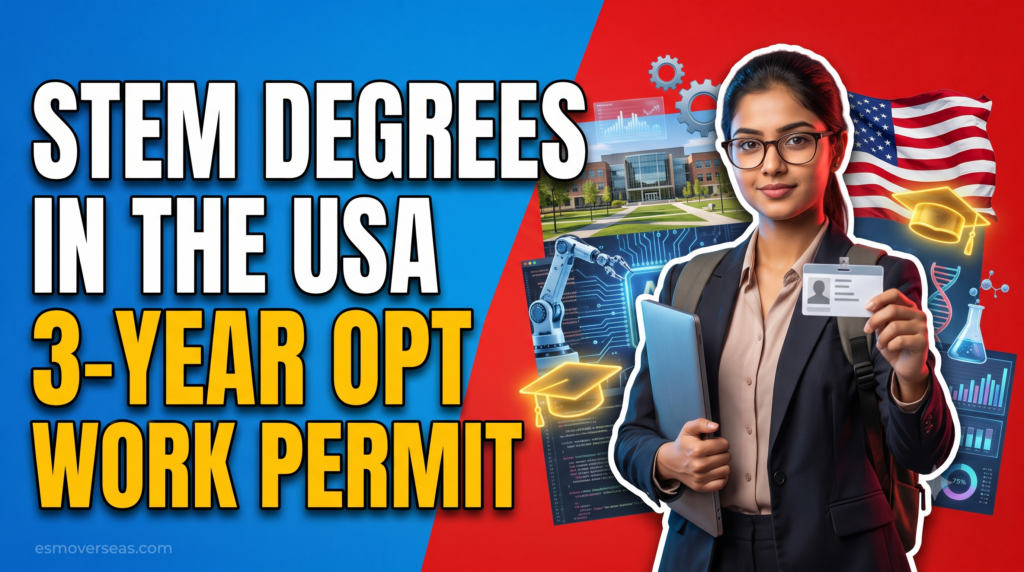
Can a STEM Degree in the USA Really Give You 3 Years of Work Authorization?
Yes, eligible Indian students who complete a STEM-designated degree in the USA can work for up to 36 months after graduation: 12 months of standard OPT plus a 24-month STEM OPT extension. You need a qualifying degree, an E-Verify employer and a training plan (Form I-983). It is not a permanent visa.
Ask any parent in Chandigarh, Mohali or Ludhiana why their child chose a master’s in Computer Science or Electrical Engineering in the USA, and you will hear the same two words: “three years.” That is the promise of STEM OPT. It is also one of the most misunderstood topics we deal with. Many families think OPT is a “3-year work visa” that comes automatically with any degree. It does not.
In our experience handling 200+ applications from Punjab, Haryana and Chandigarh, families who understand exactly how OPT works make better decisions about which course to pick, which university to choose, and how to plan their loan. This guide explains the rules in plain language, shows the real costs in rupees, and gives an honest picture of the risks.
A quick note on numbers: All dollar amounts in this article are converted to rupees at US$1 = ₹96, close to the mid-market rate in mid-September 2026 (it moved between roughly ₹95 and ₹96 over the past week). Rates change daily. Immigration rules and fees can also change, sometimes quickly, so please confirm current details on the USCIS and ICE/SEVP websites and with your university before you act.
What Exactly Is OPT? A Simple Explanation
Optional Practical Training (OPT) is a benefit for F-1 students that lets you work in the USA in a job directly related to your field of study. It is not a separate visa. You stay on your F-1 status, and the government issues a work authorization card called the Employment Authorization Document (EAD).
The three types of practical training
| Feature | CPT | Standard Post-Completion OPT | STEM OPT Extension |
| Full name | Curricular Practical Training | Optional Practical Training | 24-Month STEM OPT Extension |
| When you use it | During your degree | After completing your degree | After standard OPT, before it expires |
| Duration | As allowed by your program | Up to 12 months | Up to 24 more months |
| Degree requirement | Must be part of the curriculum | Any eligible F-1 degree | STEM-designated degree only |
| Employer requirement | Authorised by your university | Job related to your field | Employer must use E-Verify and sign Form I-983 |
| Who approves it | Your university (DSO) | USCIS (EAD) after DSO recommendation | USCIS (EAD) after DSO recommendation |
Add standard OPT (12 months) and the STEM extension (24 months), and you reach the famous total of 36 months, or 3 years.
Why is it called a “work permit”?
Many students and parents use the phrase “3-year work permit” because the EAD card looks like a work permit. Technically, OPT is a period of work authorisation attached to your student status. That is why, when your OPT ends, you must move to another status (such as H-1B), study further, or leave the USA.
What Makes a Degree “STEM” for OPT Purposes?
STEM stands for Science, Technology, Engineering and Mathematics. But here is the important point: it is not enough for your course to sound technical. Your program must appear on the US Department of Homeland Security’s official STEM Designated Degree Program List, based on its CIP (Classification of Instructional Programs) code.
Examples of programs that are commonly STEM-designated
- Computer Science, Software Engineering and Information Systems (many versions)
- Data Science, Data Analytics, Machine Learning and Artificial Intelligence
- Electrical, Electronics, Mechanical, Civil, Chemical and Industrial Engineering
- Biotechnology, Bioinformatics and several life sciences
- Mathematics, Statistics and Physics
- Some “business analytics” or “management science” programs, depending on their CIP code
The catch: the CIP code, not the course name
Two universities can offer a program with a similar name, but one may be classified as STEM and the other may not. For example, a general MBA is usually not STEM, while a Master’s in Business Analytics or Management Science may be, depending on its classification. Before paying a deposit, ask the university’s admissions team, in writing, for the CIP code and confirmation that the program is STEM-designated. ESM Overseas’ visa experts do this check for every student we counsel.
Who Is Eligible for the 24-Month STEM OPT Extension?
To qualify for the extension, you generally need to meet all of the following conditions:
- You are currently on a valid period of post-completion OPT.
- Your degree is from an accredited, SEVP-certified US institution and is on the STEM Designated Degree Program List.
- You are working for an employer who is enrolled in E-Verify, a government system that confirms work eligibility.
- Your job is directly related to your STEM degree, and it is for at least 20 hours per week.
- You and your employer complete Form I-983, a formal training plan describing your learning goals and how you will be supervised.
- You apply on time, through your university’s Designated School Official (DSO) and then to USCIS.
What about students with more than one degree?
Under current rules, students who complete a higher-level STEM degree (such as a master’s after a bachelor’s) may qualify for a second STEM extension, subject to conditions such as the earlier degree being from an accredited US institution. There is a lifetime limit of two STEM OPT extensions. Please check your case with the DSO, because this is a technical area.
What about self-employment or your own startup?
Standard OPT has some flexibility for self-employment, but the STEM extension requires a genuine employer-employee relationship, with an E-Verify employer and a training plan. Freelancing and gig work generally do not meet the STEM OPT rules.
How Much Can You Earn on STEM OPT? Realistic Salary Ranges
Pay depends on your field, your university, your internships, the location and the state of the hiring market. The table below shows broad planning ranges for entry-level roles. They are estimates, not guarantees.
| Field | Typical Annual Salary (USD) | Approx. Annual Salary (INR at ₹96/US$) |
| Computer Science / Software | US$80,000–$120,000 | ₹76.8 lakh–₹1.152 crore |
| Data Science / Analytics | US$75,000–$110,000 | ₹72 lakh–₹1.056 crore |
| Electrical / Electronics Engineering | US$70,000–$100,000 | ₹67.2 lakh–₹96 lakh |
| Mechanical Engineering | US$65,000–$90,000 | ₹62.4 lakh–₹86.4 lakh |
| Civil / Construction Management | US$60,000–$85,000 | ₹57.6 lakh–₹81.6 lakh |
| Biotechnology / Life Sciences | US$50,000–$80,000 | ₹48 lakh–₹76.8 lakh |
These figures are gross salaries before US taxes. Also remember the high cost of living in cities such as San Francisco, Seattle and New York. A salary of US$90,000 in a big coastal city may leave you with less savings than US$70,000 in a mid-sized city in Texas, Ohio or North Carolina.
Students on OPT are also generally treated differently from residents for some US taxes in their first few years (for example, Social Security and Medicare taxes), but tax rules are technical. Please speak to a qualified tax professional once you start working.
Is It Worth the Money? A Realistic Cost-and-Return Example
The dream of “3 years of OPT” is exciting, but families must look at the full picture. Here is a sample two-year master’s budget at a mid-priced public university, followed by what OPT could realistically add back.
Estimated two-year cost of a STEM master’s (public university)
| Expense (2 years) | Amount in USD | Approx. Amount in INR (at ₹96/US$) |
| Tuition and fees | US$60,000 | ₹57,60,000 |
| Living costs (rent, food, transport) | US$28,000 | ₹26,88,000 |
| Health insurance | US$3,600 | ₹3,45,600 |
| Visa fee (US$185) + SEVIS fee (US$350) | US$535 | ₹51,360 |
| Tests and application fees | US$600 | ₹57,600 |
| Total (excluding flights) | US$92,735 | ₹89,02,560 |
Scholarships, assistantships and on-campus work can reduce this. Cheaper universities and one-and-a-half-year programs can also lower the total. But for many families, the honest planning figure for a two-year master’s in a STEM field is close to ₹85 lakh–₹90 lakh.
What OPT could add back
Suppose a graduate earns a salary of US$80,000 (₹76.8 lakh) and, after US taxes, rent, food and other expenses, manages to save US$15,000–$30,000 a year (₹14.4 lakh–₹28.8 lakh). Over three years of OPT, that is US$45,000–$90,000 (₹43.2 lakh–₹86.4 lakh) in savings. That could repay a big part of an education loan, but only if the student finds a job quickly and stays employed.
This is why ESM Overseas’ visa experts stress that STEM OPT can make a US degree financially workable, yet it never removes the risk. A student who takes a large loan and then faces a 6–12 month job search on a limited OPT clock is under serious pressure. For a fuller look at costs and funding, you can read our guide on why Indian students choose the USA.
Step-by-Step: How to Get the 3-Year OPT Route
Here is the path we walk students through, from choosing a course to using the full 36 months.
- Choose a STEM-designated program: Confirm the CIP code and STEM status in writing before you pay any deposit.
- Get admission and your I-20, then obtain your F-1 visa: Prepare well for the interview; see our F-1 visa interview tips.
- Maintain your status while studying: Attend full-time, follow work rules, and use CPT only as your university allows. Be careful: a year or more of full-time CPT can make you ineligible for standard OPT.
- Apply for standard OPT near graduation: Ask your DSO to recommend OPT. You can generally apply up to 90 days before your program ends and up to 60 days after. File Form I-765 with USCIS. The fee has recently been about US$470 online or US$520 by paper (₹45,120 or ₹49,920), but check the current amount on the USCIS website.
- Wait for your EAD card: Processing times vary and can take a few months. You cannot start work until you have the card and your start date has arrived.
- Find a job related to your degree: Start early, ideally in your first semester, through internships, campus career fairs, LinkedIn and networking. Standard OPT allows a maximum of 90 days of unemployment.
- Confirm the employer’s E-Verify status: Ask before you accept an offer if you plan to use the STEM extension.
- Complete Form I-983 with your employer: This training plan must be detailed and honest. Your DSO will review it.
- Apply for the STEM extension before your OPT expires: You can file up to 90 days before your standard OPT ends. Missing the deadline can end your eligibility, so mark the dates in your calendar.
- Follow reporting rules: Report job changes, address changes and other updates to your DSO on time, and complete required evaluations of your training plan.
Key deadlines to remember
| Milestone | Typical Timing |
| Earliest date to file standard OPT | Up to 90 days before program end date |
| Last date to file standard OPT | Within 60 days after program end date |
| Maximum unemployment during standard OPT | 90 days |
| Earliest date to file STEM OPT extension | Up to 90 days before standard OPT expires |
| Maximum unemployment across STEM OPT extension | An additional 60 days (150 days total, combined) |
Rules and processing times change. Always confirm with your university’s international student office before relying on any date.
What Happens After OPT? H-1B, Further Study and Other Options
Three years sounds long, but it passes quickly. The most important question is what your plan is when OPT ends. ESM Overseas’ visa experts encourage students to build a plan for several possible outcomes.
Option 1: H-1B work visa
The H-1B is the most common next step for graduates who want to keep working in the USA. Employers register candidates in an annual selection process, and the demand is far higher than the number of visas. Having up to three years of OPT can allow a STEM graduate up to three attempts at the selection process, but there is no guarantee. The rules, wage-level requirements and fees for H-1B have been changing in recent years, so do not assume that a job offer will automatically turn into a work visa. Ask employers directly whether they sponsor H-1B and how much experience they have with it.
Option 2: Further study
Some graduates go on to a PhD or another degree. This can open a new OPT period and, in some cases, a second STEM extension, subject to the rules mentioned earlier.
Option 3: Other visa categories
Depending on your profile, options such as O-1 (for individuals with extraordinary ability) or an employer-sponsored Green Card may be possible. These are complex and case-specific.
Option 4: Move to another country or return to India
Many graduates use their US experience to move to Canada, the UK, Australia or Europe, or to return to India for senior roles, startups or family businesses. Returning with US experience is a strong advantage for many Indian employers and entrepreneurs.
Our honest advice: Treat OPT as a valuable opportunity, not as a guaranteed pathway to settle in the USA. If your plan still works when you imagine returning to India, or moving to another country, you are choosing wisely.
Risks and Policy Changes You Should Know About
OPT is a regulation-based programme, not a law written by Congress, so it can be affected by government policy. In recent years, there has been ongoing public and political debate about OPT, work visas and international student rules. We cannot predict what will change, but here is how we suggest families think about it.
- Do not build your whole financial plan on the best-case scenario. Consider what happens if you get only 12 months of OPT, or if job hunting takes longer than expected.
- Choose a course that has value beyond the USA. A strong STEM skillset is useful anywhere.
- Keep your status clean. Unauthorised work, missed deadlines or failure to report changes can end OPT eligibility.
- Watch your employers. Some “consultancies” promise jobs for a fee or ask for money from OPT students. Be cautious about any employer or agent that asks you to pay for a job or a training plan, and avoid so-called “fake experience” arrangements. They can put your status and future visas at serious risk.
- Stay informed. Follow official sources like USCIS, ICE/SEVP and your DSO, not WhatsApp forwards.
Smart Tips to Maximise Your OPT
- Start early: Begin internships and networking in your first year. The students who succeed in OPT usually built their profile long before graduation.
- Use CPT wisely: Internships during your degree can lead to full-time offers, but stay within the CPT limits.
- Build practical skills: Projects, GitHub portfolios, certifications and research experience often matter as much as grades.
- Talk to your DSO regularly: They are your best source of accurate information on your status.
- Keep records: Save your I-20s, EAD, pay slips, I-983 forms and correspondence in one secure folder.
- Choose location and university strategically: Some universities have strong industry links, career services and employer networks, which can make a big difference to job-search timelines.
Still comparing universities and courses? Our Study in USA page explains how we help students shortlist STEM programs that fit their profile and budget.
Frequently Asked Questions
1. How long is STEM OPT for Indian students in the USA?
Eligible students with a STEM-designated degree can get up to 36 months of work authorisation: 12 months of standard OPT plus a 24-month STEM extension. Students without a STEM-designated degree generally get 12 months.
2. Is OPT a work visa?
No. OPT is work authorisation linked to your F-1 student status, and you receive an Employment Authorization Document (EAD). It is temporary and does not lead automatically to a Green Card or an H-1B visa.
3. Which degrees qualify as STEM for OPT?
Your program must be on the US Department of Homeland Security’s STEM Designated Degree Program List, based on its CIP code. Course names can be misleading, so always verify the code with your university before you pay a deposit.
4. Does my MBA qualify for the 3-year OPT?
A general MBA usually does not. Some business programs, such as business analytics or management science, may be STEM-designated depending on their CIP code. Confirm this in writing with the university.
5. How much does it cost to apply for OPT?
The Form I-765 filing fee has recently been about US$470 online or US$520 by paper, which is ₹45,120 or ₹49,920 at ₹96 per dollar. Fees can change, so check the USCIS website before you file.
6. Can I change jobs during STEM OPT?
Yes, but the new employer must also be enrolled in E-Verify, the job must relate to your degree, and you must complete a new Form I-983 and report the change to your DSO on time. Long gaps between jobs can count against your unemployment days.
7. Can I do OPT if I do CPT during my degree?
Yes, in most cases. But 12 months or more of full-time CPT can make you ineligible for standard OPT, so track your CPT days carefully with your DSO.
8. Does STEM OPT guarantee an H-1B or a Green Card?
No. OPT gives you time to work and, for STEM graduates, more chances to be selected for an H-1B, but selection is competitive and rules change. A strong plan should not depend on a single outcome.
Thinking About a STEM Degree in the USA? Let Us Talk It Through, With No Pressure
Choosing a STEM program is not only about getting into a university. It is about selecting the right course, checking its STEM status, planning the money, and preparing for life after graduation. The team at ESM Overseas is happy to give you clear, honest advice, including when another country or course might suit you better.
Book a free 15-minute consultation with ESM Overseas’ visa experts. Parents are always welcome to join, and there is no obligation.
- Call or WhatsApp: +91-7087217801
- Visit us: ESM Overseas, SCO 375-376, Sector 35B, Chandigarh
- Online: Book your free consultation here or read our visa guidance page for more help.
Disclaimer: This article is for general guidance only and is not legal or immigration advice. OPT rules, fees, processing times and visa policies change often. The US$1 = ₹96 rate used here is indicative. Please verify current details with USCIS, ICE/SEVP and your university’s Designated School Official (DSO) before making decisions.