Why Do USA Student Visas Get Rejected?
Most USA student visa rejections happen not because of who the student is, but because of how the application is presented. The three biggest reasons F-1 visas get refused are weak or unclear financial documentation, an inability to explain study plans and post-study intentions confidently, and inconsistencies between the I-20, DS-160 form, and interview answers. Almost all of these are preventable with the right preparation.
Every year, thousands of students from Punjab, Haryana, and Chandigarh apply for the F-1 student visa to study in the United States, and every year, a meaningful number of otherwise strong candidates get turned away at the visa counter. It is heartbreaking to see a student with a genuine admit letter, a good academic record, and a real plan for the future walk out of the interview with a blue slip instead of a stamped passport. In our experience handling 200+ F-1 visa applications at ESM Overseas, the difference between an approval and a rejection almost always comes down to preparation, clarity, and consistency — not luck.
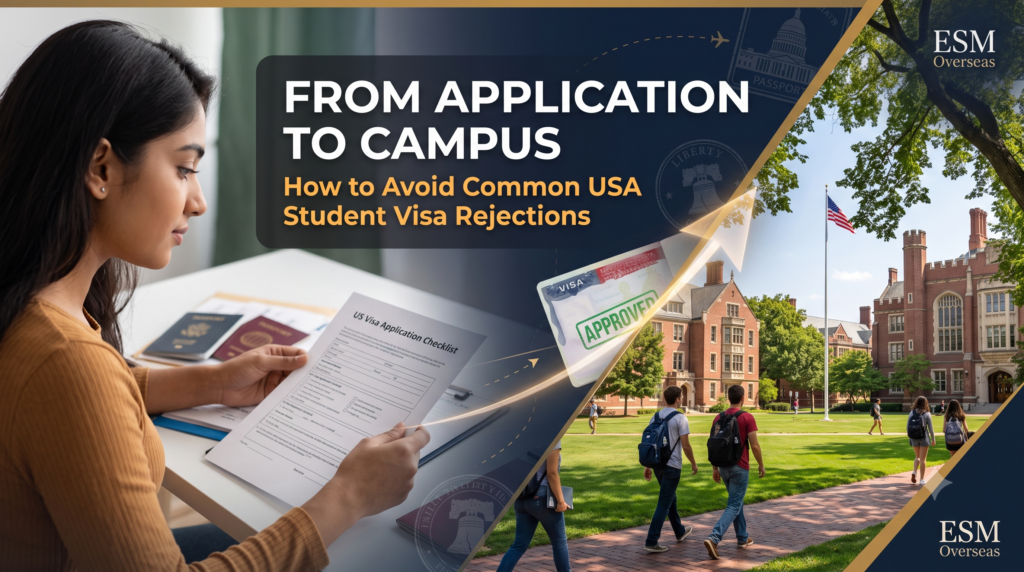
This article walks you through the entire journey, from the moment you accept your university offer to the day you land on campus, and shows you exactly where students slip up and how to avoid it.
Understanding the F-1 Visa Journey: From I-20 to Campus
Before we get into what goes wrong, it helps to understand what the process actually looks like. Most Indian students underestimate how many steps stand between “I got my admit” and “I’m walking into my first lecture,” and rushing through any one of them is where trouble usually starts.
| Stage | What Happens | Typical Timeline (2026) |
| University admission & I-20 issuance | You receive your offer letter and the university issues Form I-20 once you confirm enrolment and show proof of funds | 2–6 weeks after acceptance |
| SEVIS I-901 fee payment | Paid online at fmjfee.com to register you in the SEVIS system | Same day, before DS-160 |
| DS-160 form submission | Online, non-immigrant visa application form with your travel, education, and family details | 1–2 hours to complete carefully |
| Visa fee payment & interview slot booking | MRV fee paid, appointment booked at the nearest US consulate (Chandigarh, Delhi, or Mumbai) | Slots often 3–8 weeks out in peak season (May–August) |
| Visa interview | In-person interview and biometrics at the consulate | 5–10 minutes on average |
| Visa issuance & travel | Passport with visa stamp returned via courier | 3–7 working days after approval |
| Pre-departure & arrival | Booking flights, arranging accommodation, attending university orientation | Ideally 2–4 weeks before program start |
Notice how many touchpoints there are. A small error at any one of these stages — a mismatched date, an unexplained gap, an unclear answer — can create doubt in the visa officer’s mind. And under US visa law, the consular officer does not need to prove you are lying; you need to convincingly prove your intent to study and return, under Section 214(b) of the Immigration and Nationality Act, which is the legal basis for the overwhelming majority of student visa refusals.
The Top Reasons USA Student Visa Applications Get Rejected
ESM Overseas’ visa experts have reviewed rejection patterns across hundreds of cases, and the same handful of issues keep showing up. Here is what actually causes refusals, in the order we see them most often.
1. Weak or Unconvincing Financial Proof
This is, by far, the number one reason for rejection among students from Punjab and Haryana. It is not enough to simply have money in the bank — you need to show where that money came from, and that it has been available for a reasonable period, not deposited two weeks before the interview. Sudden, large, unexplained deposits are one of the fastest ways to trigger a refusal, because they raise questions about the legitimacy of the funding source.
2. Inability to Justify the Choice of Course or University
Visa officers frequently ask “Why this university?” and “Why this course?” Students who picked a college mainly because an agent recommended it, or because the fee was low, often struggle to answer convincingly. A weak answer here suggests the study plan itself may not be genuine.
3. Poor Communication and Rehearsed Answers
Interviews are short — often under five minutes — and officers are trained to notice memorised, robotic responses. Ironically, students who over-prepare scripted answers sometimes come across as less genuine than those who speak naturally about their goals.
4. Unclear Post-Study Intentions (“Immigrant Intent”)
The F-1 visa is a non-immigrant visa, which legally requires you to convince the officer you intend to return to India after your studies (or maintain strong ties to India even if you later pursue OPT). Vague answers about “settling abroad” without any grounding in family, property, career plans, or ties back home can raise red flags.
5. Mismatched or Inconsistent Documentation
Dates, names, or figures that do not match across the I-20, DS-160, bank statements, and academic transcripts are an easy reason for an officer to doubt the application. Even small typos can matter.
6. Gaps in Academic History
Unexplained study gaps, especially of a year or more, need a clear and honest explanation — whether it was due to preparing for entrance exams, work experience, or family circumstances. Leaving it unaddressed looks worse than explaining it clearly.
7. Choosing a Course That Doesn’t Match Academic Background
A sudden, unexplained switch — for example, from a commerce background straight into a computer science master’s with no bridge coursework or reasoning — can make an officer question whether the plan is genuine or driven purely by immigration goals.
| Common Rejection Reason | What It Looks Like | How to Avoid It |
| Weak financial proof | Recent lump-sum deposits, unclear source of funds, insufficient liquid balance | Show funds seasoned for at least 3–6 months, keep loan sanction letters and ITRs ready |
| Unclear study plan | Can’t explain why this course, university, or ranking | Research the program, professors, and curriculum; connect it to your academic background |
| Rehearsed answers | Robotic, memorised responses that don’t match follow-up questions | Practice mock interviews, but speak in your own words, not a script |
| Weak home ties | No clear reason to return, vague answers on future plans | Be honest and specific about family, career, and post-study plans in India |
| Document mismatches | Different spellings, dates, or figures across I-20, DS-160, and bank papers | Cross-check every document line by line before the interview |
| Unexplained academic gaps | Gap years with no context offered | Prepare a short, honest explanation supported by documents if available |
The Real Cost of a US Study Visa (2026)
Budgeting correctly matters for two reasons: it helps you prepare the right financial documents, and it protects you from unpleasant surprises. Here is an accurate breakdown of the mandatory government fees for the F-1 visa in 2026, based on the latest rates published by the US Department of State and the Student and Exchange Visitor Program (SEVP).
| Fee | Amount (USD) | Approx. Amount (INR) | Paid To / When |
| SEVIS I-901 fee | $350 | ₹33,250 | fmjfee.com, before DS-160 submission |
| DS-160 visa application (MRV) fee | $185 | ₹17,575 | US visa fee portal, before scheduling interview |
| Visa Integrity Fee (new in 2026) | $250 | ₹23,750 | At time of visa issuance |
| Total mandatory government fees | $785 | ₹74,575 | — |
These figures are calculated at an approximate exchange rate of ₹95 per US dollar (as of September 2026); actual amounts will vary slightly with daily forex rates. On top of the government fees above, students should budget for the additional pre-departure and on-campus costs below.
| Additional Cost | Amount (USD) | Approx. Amount (INR) | When It’s Paid |
| Passport courier / delivery charges | ~$12–$21 | ₹1,000–₹2,000 | After interview, for passport return |
| Photographs & documentation | ~$5–$10 | ₹500–₹1,000 | Before DS-160 / interview |
| Health insurance (per year, on campus) | $500–$3,000 | ₹47,500–₹2,85,000 | At university enrolment, annually |
| Total first-year cost of attendance (tuition + living, typical Master’s) | ~$45,000 | ~₹42,75,000 | Shown as financial proof for the visa |
For the financial proof itself, most US universities and consular officers expect you to demonstrate funds covering at least this first year’s total cost of attendance. ESM Overseas’ visa experts generally recommend building this amount from a clear, well-documented combination of sources rather than one single unexplained deposit, structured roughly as follows:
| Funding Source | Typical Share | Approx. Amount (on ₹42,75,000 total) |
| Education loan (sanctioned) | ~70% | ₹29,92,500 |
| Family savings / fixed deposits | ~20% | ₹8,55,000 |
| Provident fund / gold / other liquid assets | ~10% | ₹4,27,500 |
Step-by-Step: How to Build a Rejection-Proof F-1 Visa Application
Here is the process we walk every student through at our Chandigarh office before their interview date. Following these steps in order significantly reduces the chances of a refusal.
- Finalise your university and course with intent, not convenience. Choose a program that logically follows from your academic background and career goals, not just the one with the easiest admission.
- Start financial planning at least 4–6 months in advance. Seasoned funds look far stronger than a sudden deposit. If you are taking an education loan, apply early so the sanction letter is ready well before your interview.
- Collect and organise every document methodically. This includes your I-20, admission letter, academic transcripts from Class 10 onward, IELTS/TOEFL/GRE scores, bank statements, income tax returns of your sponsor, and the loan sanction letter.
- Pay the SEVIS I-901 fee and keep the receipt safe. Print it immediately — do not rely only on the email confirmation.
- Fill the DS-160 form carefully and cross-check every field. Match names, dates, and addresses exactly with your passport and I-20. Small clerical errors are a common, easily avoidable cause of delay or doubt.
- Book your visa interview slot as early as possible. Peak season (May to August) sees appointment wait times stretch to 6–8 weeks at busy consulates, so book the moment your DS-160 and fee payment are done.
- Prepare for the interview through practice, not memorisation. Do at least two to three mock interviews focused on your study plan, financial background, and future intentions — but answer in your own natural words each time.
- Dress simply, arrive early, and stay calm and honest in the interview. Officers are trained to notice confidence built on genuine understanding, not on a rehearsed script.
- Keep a folder of original documents on hand during the interview, even though officers may only ask for a few. Being able to produce anything requested instantly builds credibility.
Common Mistakes Students From Punjab and Haryana Make
Because ESM Overseas is based in Chandigarh and works closely with families across Punjab and Haryana, certain patterns show up again and again in our region specifically.
- Over-reliance on relatives’ sponsorship without clear paperwork. It’s common for a maternal uncle or family friend abroad to offer to sponsor a student, but without a notarised affidavit of support and clear proof of relationship, this can weaken the application significantly.
- Selling agricultural land or property right before the interview. While this is a legitimate way to fund education, doing it too close to the interview date without documentation of the sale and its use makes the money look sudden and unexplained.
- Choosing universities based purely on peer or relative recommendations. “My cousin went there” is not, on its own, a strong reason in a visa interview — you need your own academic and career reasoning.
- Underestimating English communication practice. Even strong IELTS scorers sometimes freeze in a real interview setting simply due to nervousness, not lack of ability. Practice under realistic conditions matters.
- Applying through unverified local agents promising “guaranteed visas.” No one can guarantee a US visa outcome — genuine consultancies help you prepare a strong, honest case, not shortcuts.
What Happens After Visa Approval — Preparing for Campus
Getting the visa stamped is a huge milestone, but the journey to campus isn’t quite finished. In our experience, students who plan this final stretch well settle in far more smoothly.
Before You Fly
Book flights that arrive within the window mentioned on your I-20 — typically, F-1 students may enter the US up to 30 days before their program start date, though this is subject to change, so always confirm current guidance closer to your travel date. Arrange your first few nights of accommodation before departure, even if it’s temporary, so you are not searching for a place to stay while jet-lagged.
What to Carry
Keep your original I-20, passport with visa stamp, SEVIS fee receipt, admission and financial documents, and a few passport-sized photographs in your hand baggage, not checked luggage. Immigration officers at the US port of entry will ask to see these.
On Arrival
Complete your university’s international student check-in and orientation promptly — this activates your SEVIS record and is often mandatory within the first few days. Set up a US bank account and local phone number early, as both are needed for practical day-to-day life, from rent to part-time work authorisation.
The First Few Weeks
Understand your on-campus work rules (F-1 students can generally work up to 20 hours per week on campus during the semester), locate your Designated School Official (DSO), and keep a copy — physical and digital — of every immigration document for the rest of your stay.
How ESM Overseas Helps
At ESM Overseas, we don’t believe in shortcuts or “guaranteed visa” promises — because no consultancy can ethically make that guarantee. What we do offer is structured, honest preparation: reviewing your financial documentation for consistency, running realistic mock interviews, helping you build a study plan that genuinely reflects your academic background and goals, and double-checking every form before submission so avoidable errors don’t cost you your visa. You can read more about our approach on our visa guidance page, or explore country-specific requirements on our USA study page.
If your visa was previously refused, don’t lose heart — a large number of our successful cases are students who came to us after an earlier rejection elsewhere. A refusal is not a permanent mark against you; it’s information about what needs to be stronger the next time.
Frequently Asked Questions
What is the most common reason for USA student visa rejection?
The single most common reason is weak or unconvincing financial documentation — either insufficient funds or an unclear, sudden source of money. The second most common reason is an unclear or unconvincing study plan and post-study intention.
Can I reapply for a US student visa after rejection?
Yes. There is no mandatory waiting period, and many students reapply successfully within weeks once they address the specific concerns raised at the earlier interview. It helps to understand exactly why you were refused (often noted briefly on your refusal slip under Section 214(b)) before reapplying.
How much bank balance is required for a US student visa?
You generally need to show funds covering at least the first year’s total cost of attendance (tuition plus living expenses), which for most Master’s programs in the US ranges from roughly $35,000 to $60,000 (approximately ₹33,25,000 to ₹57,00,000), through a combination of education loans, savings, and sponsor income.
How long does the F-1 visa process take in 2026?
From DS-160 submission to visa stamping, the process typically takes 4 to 8 weeks in total, including interview wait times, though this can stretch further during the May–August peak season. Applying early is strongly recommended.
Does an education loan hurt my visa chances?
No — a sanctioned education loan is viewed as a legitimate and common funding source, provided you also show some family contribution and the loan sanction letter is clear and complete. Relying entirely on unexplained cash, on the other hand, is far riskier.
What questions are typically asked in a US student visa interview?
Officers commonly ask about your chosen course and university, how you plan to fund your education, your academic background, your plans after graduation, and your ties to India. Answers should be clear, specific, and delivered in your own words.
Is it true that visa officers reject students who don’t speak fluent English?
Not directly — visa officers are assessing your intent and credibility, not grading your grammar. That said, clear communication does help you explain your case confidently, so practising spoken English in a low-pressure setting before the interview is genuinely useful.
Can ESM Overseas help if I’ve already been rejected once?
Yes. We regularly work with students who were refused elsewhere, review exactly what likely went wrong, and help rebuild a stronger, more consistent application before the next attempt. You can reach out via our contact us page to discuss your specific case.
Let’s Prepare Your Application Together
Every rejection we’ve seen was avoidable in hindsight — and that’s exactly why careful, honest preparation matters so much. If you or your child is preparing to apply for a US student visa, we’d be glad to look at your profile and tell you honestly where it stands.
Book a free 15-minute consultation with our team — no pressure, no obligation, just a clear conversation about your options. Call or WhatsApp us at +91-7087217801, or visit us at our Chandigarh office:
ESM Overseas
SCO 375-376, Sector 35B, Chandigarh
You can also learn more on our contact us page or browse our visa guidance resources before you get started. We’re here to help you get it right the first time.