How Do You Pass the F-1 Visa Interview?
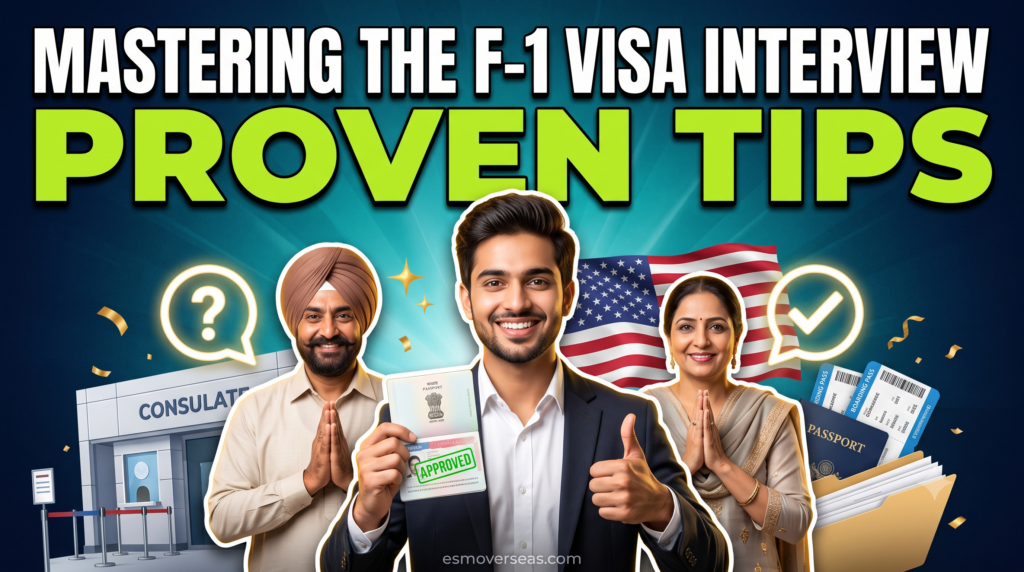
To pass your F-1 visa interview, be ready to explain clearly why you chose your course and university, how you will pay for it, and why you will return to India after studying. Keep answers short and honest, carry organised original documents, and stay calm. Consular officers usually decide within a few minutes.
If your stomach tightens at the thought of standing in front of a US visa officer, you are in good company. Almost every student who walks into our Sector 35B office in Chandigarh tells us the same thing: “I have my admission and my funds, but I am scared of the interview.” That fear is understandable. The interview is short, the officer is a stranger, and it feels like your whole future depends on a few minutes.
The good news is that the F-1 interview is far more predictable than it looks. In our experience handling 200+ applications from Punjab, Haryana and Chandigarh, the students who do well are rarely the ones with the fanciest English. They are the ones who know their own story, can explain it simply, and can back it up with clear documents. This guide walks you through exactly how to prepare.
A quick note on numbers: Any dollar amounts in this article are converted to rupees at US$1 = ₹96, which is close to the mid-market rate in mid-September 2026 (it moved between roughly ₹95 and ₹96 over the past week). Exchange rates change daily, and fees and rules can change too, so please confirm the latest details on the official US government websites before you pay anything.
What Is the F-1 Visa Interview, and Why Does It Matter So Much?
The F-1 is the visa for full-time academic study at US colleges and universities. Even with a genuine admission letter (Form I-20), the visa is not automatic. A US consular officer must be satisfied that you are a genuine student, that you can afford your studies, and that you intend to leave the USA after your program ends.
Legally, this last point is the heart of the matter. US law presumes that every visa applicant may want to settle in the USA, and the student must convince the officer otherwise. When an officer is not convinced, the refusal is usually issued under Section 214(b) of the US Immigration and Nationality Act. It sounds scary, but in simple words it means: “The officer was not satisfied that you will return home after your studies.”
The three things every officer is really checking
- Are you a genuine student? Does your course make sense with your background, and do you know why you chose it?
- Can you pay? Do you have credible, documented funds for tuition and living costs, and do you understand your own financing?
- Will you come back? Do you have realistic plans, family, career prospects or other ties that make returning to India sensible?
Everything you say and show in the interview should quietly answer these three questions. Keep them in mind and the rest becomes much easier.
What Does the Visa Process Cost? A Clear Fee Breakdown
Before the interview, you will pay certain government fees. Here is what our team tells students to budget for, converted at ₹96 per US dollar.
| Item | Amount in USD | Approx. Amount in INR (at ₹96/US$) |
| F-1 visa application fee (MRV fee) | US$185 | ₹17,760 |
| SEVIS I-901 fee | US$350 | ₹33,600 |
| Total mandatory government fees | US$535 | ₹51,360 |
| Travel to the interview city and stay (Delhi is the usual choice for Punjab and Haryana students) | — | ₹3,000–₹10,000 (depending on mode of travel and stay) |
| Photocopies, folder, printing, translations if needed | — | ₹500–₹3,000 |
| Reapplication after a refusal (new visa fee) | US$185 | ₹17,760 |
Please note: US law has introduced a new “visa integrity fee” of US$250 (₹24,000 at today’s rate) for certain non-immigrant visas, and how and when it is collected has been unclear. Check the US Department of State website or ask our team for the latest position before you budget.
The proof of funds matters even more than the fees. Your I-20 shows the estimated first-year cost set by the university. For a typical master’s student at a public university, that can be about US$46,935 (₹45,05,760), which includes tuition, living costs, insurance, fees and application expenses. The officer will want to see that you have credible access to at least that amount for the first year, and a realistic plan for the rest of your degree.
Step-by-Step: From DS-160 to Interview Day
Here is the process our visa experts follow with students, so that nothing is missed.
- Receive your Form I-20: Check that your name, date of birth, course, start date and funding details are 100% correct. Errors here cause trouble later.
- Pay the SEVIS I-901 fee (US$350, or ₹33,600): Save the payment receipt; you will need it at the interview.
- Complete the DS-160 online form: This is your main visa application. Be truthful and consistent with your I-20, passport and documents. Small mismatches can create big doubts.
- Pay the visa application fee (US$185, or ₹17,760): Follow the current payment instructions on the official appointment website.
- Book your visa interview and biometrics: Appointment wait times change with season and city, so check the official portal regularly. Book as early as your program start date allows.
- Prepare your document folder: Keep originals and one set of photocopies, neatly arranged in the order the officer is likely to ask for them.
- Practise mock interviews: Do at least three to five practice rounds with a friend, teacher or our team. Record yourself once, it feels awkward but helps a lot.
- Attend your interview: Arrive early, follow security instructions, and remember that phones and bags are often restricted, so carry only what is required.
- Receive the decision: Many applicants hear the outcome at the end of the interview. If approved, the passport usually returns by courier within about a week. Some cases go for “administrative processing”, which can take several more weeks.
Realistic timeline: From getting your I-20 to holding your visa, most students take about 4–8 weeks, depending on appointment availability. If you are still choosing universities, our Study in USA page explains the whole journey.
The Documents You Should Carry
Officers often decide based on the conversation more than the paperwork, and many applicants are never asked to show most of their files. But you must have everything ready, because the one time you do not have it may be the one time it is asked for.
Must-have documents
- Valid passport (and old passports, if any)
- Form I-20 signed by you and the university
- DS-160 confirmation page with barcode
- Visa fee payment receipt and SEVIS I-901 receipt
- Interview appointment confirmation
- Recent photographs as per the official specifications
Academic documents
- Class 10, Class 12 and degree mark sheets and certificates
- Test scores such as IELTS, TOEFL, Duolingo, GRE or GMAT, where applicable
- University offer letter and any scholarship or assistantship letters
- Resume, work experience letters and projects (if relevant)
Financial documents
- Education loan sanction letter (if applicable)
- Bank statements for the last 6–12 months of the sponsor(s)
- Income Tax Returns of the sponsor for the last 2–3 years, with Form 16 or CA-certified income proof where relevant
- Fixed deposit receipts, mutual fund statements or other savings proofs, with clear ownership
- Property or business documents, if these are part of the funding
Golden rule on funds: Never show “borrowed for the day” money or funds that suddenly appeared in the account just before the interview. Officers are trained to look for unexplained large deposits. In our experience, a smaller amount that is clearly explained and steadily built is far safer than a big amount with no story.
The Most Common F-1 Interview Questions (and How to Answer Them)
The interview is normally conducted in English, and questions are short. Here are the ones our visa experts hear most often from students in our region, with tips on what a strong answer looks like. These are guides, not scripts. Please never memorise a paragraph and recite it, because officers can tell.
Study plan questions
| Question | Weak Answer | Strong Answer |
| Why do you want to study in the USA? | “Because it is the best country.” | A specific reason linked to your course, such as the program’s curriculum, labs or faculty in your field. |
| Why this university? | “My friend studies there.” | Two or three concrete points: courses, research areas, industry links, location and fit with your goals. |
| Why this course? | “It has good jobs.” | How the course builds on your Bachelor’s degree, work or projects, and your career goal. |
| Which other universities did you apply to? | Cannot name them. | Name them honestly and explain why this one is your choice. |
Financial questions
- “Who is sponsoring your studies?” Answer directly: “My father, who runs a business in Ludhiana.” Be ready to explain the sponsor’s occupation and income in a sentence or two.
- “How much will your program cost?” Know the number from your I-20. For example: “The first-year cost is about US$46,935, roughly ₹45 lakh, and we have arranged it through savings and an education loan.”
- “What is your father’s annual income?” Give an honest figure that matches your documents.
- “Do you have any relatives in the USA?” Answer truthfully. Having relatives is not a problem by itself, but hiding them is.
Return-intent questions
- “What will you do after your degree?” Give a realistic plan connected to India, for example a role in your family’s business, a job in your field, or a startup idea.
- “Do you plan to work in the USA after graduation?” Be honest but careful. You can say you would like to gain practical experience through the work rights allowed for students, and then return to apply your skills in India. Do not claim you will “definitely settle in the USA” or that you have “no plans to work at all”, because neither is convincing.
- “Why will you come back?” Mention family responsibilities, career opportunities, business plans or property and other real ties.
Academic background questions
- “Why did you have a gap after graduation?” Explain honestly, with proof if you have any (a job, coaching, a course, or family reasons).
- “Why are you changing fields?” Show a clear bridge, such as a certification, project or internship that led to your new interest.
- “What was your CGPA or percentage?” Know it, and know your test scores.
Ten Proven Tips From Our Visa Experts
These tips come from the questions parents and students bring to our Chandigarh office every week.
1. Know your own file inside out
You should be able to explain every line of your DS-160, I-20 and resume without looking. If someone else filled parts of it, sit down and read it carefully together.
2. Keep answers short and direct
Officers see a very large number of applicants each day. Answer the question asked in one or two sentences. If they want more, they will ask.
3. Speak in your own words
You do not need a “perfect” accent. Clear, simple English is enough. If you do not understand a question, politely ask the officer to repeat it.
4. Be honest, always
A mistake can be explained, but a misrepresentation can cause serious long-term problems for future US visa applications. If you do not know an answer, say so. Never invent a story or use fake documents, and please never trust anyone who suggests it.
5. Dress neatly and appear confident
Business casual is fine. Look at the officer, smile naturally when you greet them, and keep your hands relaxed. First impressions matter, but there is no need to overdo it.
6. Come alone, and let parents wait outside
The F-1 interview is for the student. Parents may accompany you to the city and wait outside, but you should be ready to answer for yourself. If the officer wants to speak to a sponsor, they will say so.
7. Take care of your online presence
US authorities have introduced additional online-presence vetting for student visa applicants, and applicants may be asked to make their social media accounts public. Make sure your public posts are respectful and consistent with what you tell the officer, and follow the latest instructions on the official website.
8. Do not talk about “settling” or “PR” in the USA
It is fine to say you value gaining international experience. But statements about permanent residence or staying forever can raise red flags for an F-1 visa, which is a temporary student visa.
9. Stay calm if you get a tough question
Take a breath and answer as clearly as you can. If one answer feels imperfect, do not panic. Interviews are judged as a whole, not on one sentence.
10. Do mock interviews with feedback
This single habit makes the biggest difference we see. Students who practise out loud, in front of someone who gives honest feedback, perform much better than students who only read questions online.
Common Reasons for F-1 Visa Refusal (and How to Avoid Them)
Every refusal is a personal experience, and we never want to judge a student for it. But some patterns show up repeatedly. Here are the ones ESM Overseas’ visa experts see most often.
| Common Reason | What It Looks Like | How to Reduce the Risk |
| Weak return intent (214(b)) | Vague plans after graduation, or talk of settling in the USA | Prepare a realistic India-based career plan and mention genuine ties |
| Unclear or unexplained funds | Large recent deposits, sponsor cannot explain income | Use funds built over time, keep proofs clean, and know the source of every rupee |
| Poor knowledge of course/university | Cannot explain why this program or how it fits your background | Research your program thoroughly and link it to your goals |
| Inconsistent answers | Answers differ from DS-160 or documents | Review your forms and documents before the interview |
| Rehearsed, robotic answers | Memorised paragraphs that do not answer the question asked | Practise key points, not scripts |
| Study gap without explanation | Long gap with no job, course or reason | Prepare a truthful explanation with supporting proof |
What if my visa is refused?
A refusal is painful, but it is not the end. You can reapply, but you will need a new DS-160, a new visa fee (US$185, or ₹17,760) and a new appointment. Before you reapply, understand exactly why the first attempt did not work and what has changed. Reapplying with the same story and documents rarely helps. Our team is happy to review your case honestly, and you can contact us for a free chat.
Interview Day Checklist
Keep this list handy in the last week before your interview.
- Passport, I-20, DS-160 confirmation, fee receipts and appointment letter
- Academic, test and financial documents in one organised folder
- Route to the consulate or visa application centre planned in advance
- Reached the location early, with a buffer for security checks
- Simple, neat clothes, a good night’s sleep and a light breakfast
- Your key points revised: study plan, funding, return plan
- A calm mindset: you are there to tell your honest story
For a detailed document checklist and updates on procedures, visit our visa guidance page.
A Note for Parents
Parents from Punjab and Haryana often carry as much stress as their children, especially when a large amount of family savings or a loan is involved. Here is how you can help in a meaningful way:
- Keep the financial documents organised, up to date and easy to explain.
- Do not coach your child to give “safe” or “perfect” answers. Encourage honesty and confidence instead.
- Be available for a calm conversation after the interview, whatever the result.
- Have a backup plan discussed in advance, such as another intake, another university or another country.
Your support and calm matter more than any script.
Frequently Asked Questions
1. How long does the F-1 visa interview take?
Most interviews last only a few minutes, and the officer may ask just a handful of questions. Because it is so short, clear and confident answers matter a lot.
2. Which questions are asked most often in the F-1 visa interview?
Common questions cover why you chose your course and university, how you will fund your studies, who your sponsor is, and what you plan to do after graduation. Officers may also ask about your academic background and any study gaps.
3. Can I take my parents into the interview?
Usually, no. The interview is for the student, and parents typically wait outside. If the officer needs to speak with a sponsor, they will let you know.
4. How much does the F-1 visa cost from India?
The visa application fee is US$185 (₹17,760) and the SEVIS I-901 fee is US$350 (₹33,600), a total of US$535 (₹51,360) at ₹96 per dollar. Fees and rules can change, so check the official website before you pay.
5. How much bank balance is needed for an F-1 visa?
There is no single fixed balance. You need to show enough credible funds to cover the first-year costs on your I-20 (for example, about US$46,935, or ₹45,05,760, for many master’s programs) and a realistic plan for the remaining years. The source and history of the funds matter as much as the amount.
6. What happens if my F-1 visa is refused?
You will receive a reason, often under Section 214(b). You can reapply with a new application, a new fee and a new appointment. It is best to fix the weak areas first, such as clarity of plans, funding proof or knowledge of your course.
7. Is it a problem if I have relatives in the USA?
Not by itself. Answer honestly if asked. Problems arise when relatives are hidden, or when the officer believes your main plan is to join family and settle there.
8. Can I apply for the F-1 visa without an IELTS or TOEFL score?
It depends on your university. Some accept alternatives to IELTS or TOEFL, or waive the requirement, but you must still show that you can speak and understand English well enough in the interview. Confirm the rule with your university and prepare for a fully English interview.
Want a Mock Interview Before the Real Thing? We Are Happy to Help
Preparing for your visa interview does not have to be a lonely, stressful process. At ESM Overseas, our team runs friendly, practical mock interviews and reviews your documents so you feel prepared, not scripted. We will tell you honestly where your file is strong and where it needs attention. There is no pressure and no obligation.
Book a free 15-minute consultation with ESM Overseas’ visa experts. Parents are very welcome to join the conversation.
- Call or WhatsApp: +91-7087217801
- Visit us: ESM Overseas, SCO 375-376, Sector 35B, Chandigarh
- Online: Book your free consultation here
Disclaimer: This article is for general guidance only and does not guarantee a visa outcome. Visa decisions are made solely by US consular officers. Fees, procedures and policies change often; the US$1 = ₹96 rate used here is indicative. Please verify current details with the US Department of State and the official appointment website before making decisions.