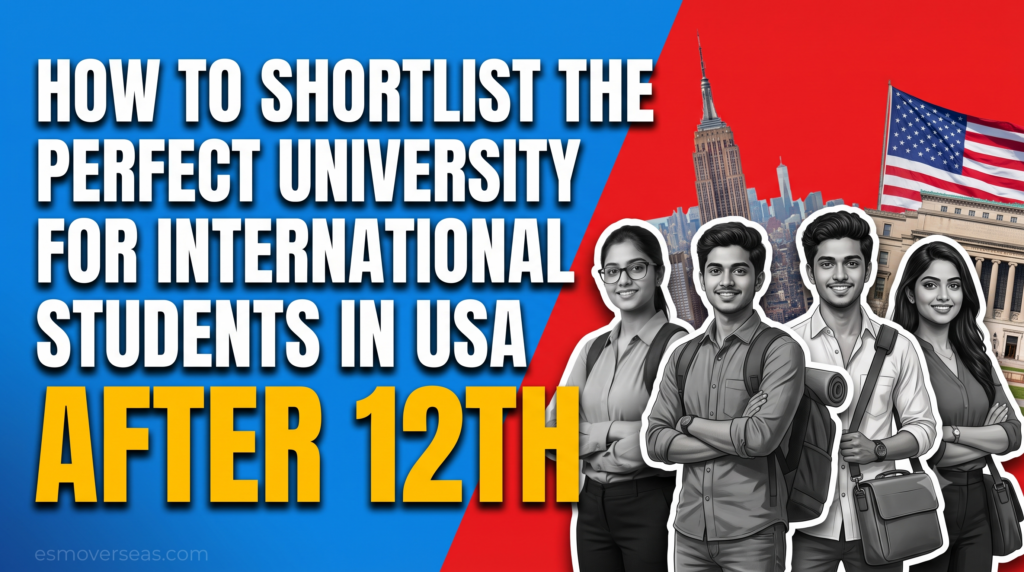
Why Shortlisting the Right University Matters More Than Chasing Rankings
To shortlist the perfect US university after 12th, match your academic profile, budget, and career goals against 6–8 institutions split across safety, match, and reach categories, then compare their course curriculum, scholarship availability, location, and post-study work options before finalising your list of 4–6 applications.
Every year, thousands of students from Punjab, Haryana, and Chandigarh reach out to us right after their board results, unsure of where to even begin. Many arrive with a list built entirely from Google’s “top 10 US universities” searches — a list that rarely fits their marks, budget, or career direction. In our experience handling 200+ applications at our Chandigarh office, students who shortlist thoughtfully — rather than chasing a famous name — end up with better admits, better scholarships, and a much smoother visa interview, simply because their “why this university” answer is genuine.
This guide walks you through a practical, step-by-step method to shortlist US universities after 12th, along with real cost figures in INR and USD, a comparison of university types, and answers to the questions parents ask us most often.
Step-by-Step Process to Shortlist US Universities After 12th
Shortlisting isn’t a one-evening task — it’s a research process that, done properly, takes 3–5 weeks. Here is the exact sequence our counsellors walk students through.
- Assess your academic profile honestly. List your Class 12th percentage, any standardised test scores (SAT/ACT if applicable), English proficiency test plans (IELTS/TOEFL/Duolingo), and extracurriculars. Universities admit on fit, not just marks.
- Define your budget ceiling in INR first. Decide, as a family, the maximum you can comfortably fund per year — tuition plus living costs — before you fall in love with a university you can’t afford.
- Shortlist by course strength, not overall ranking. A university ranked 150th overall can have a top-20 program in your specific major. Search program-specific rankings, not just the general list.
- Split your list into Safety, Match, and Reach categories. Aim for roughly 2 safety, 3 match, and 1–2 reach universities, so you have solid backup options alongside your ambitious picks.
- Check post-study work rights and OPT/STEM extension eligibility for your chosen major, since this affects your ability to work in the US after graduation.
- Shortlist for scholarships and assistantships early. Merit scholarships are often awarded at the time of admission, so apply to universities known for generous aid to international students.
- Verify visa and compliance track record. Choose SEVP-certified institutions with a strong history of visa approvals for Indian students — this is something ESM Overseas’ visa experts check for every student before recommending a university.
- Finalise 4–6 universities and start applications 8–10 months before your intended intake, keeping deadlines, SOPs, and recommendation letters on a single tracked calendar.
Safety, Match, and Reach: How to Balance Your List
A well-balanced shortlist protects you from ending up with no offers, or only offers you can’t afford. Here’s how our counsellors define each category and what proportion of your list each should occupy.
| Category | What It Means | Recommended Share of List |
|---|---|---|
| Safety | Your profile comfortably exceeds the university’s typical admitted-student range; high chance of admission and scholarship. | 2 universities |
| Match | Your profile aligns closely with the average admitted student; realistic chance with a strong application. | 2–3 universities |
| Reach | Highly selective or above your current profile strength; possible but not guaranteed, even with a strong SOP. | 1–2 universities |
Comparing US University Types Before You Shortlist
Not every strong university is a private research institution. Community colleges, state universities, private universities, and Ivy League schools each serve a different budget and career path. The table below, compiled from our 2026 counselling data, gives you a realistic starting point.
| University Type | Typical Annual Tuition (USD) | Approx. Tuition (INR)* | Best Suited For |
|---|---|---|---|
| Community College | $8,000 – $14,000 | ₹7.7L – ₹13.5L | Budget-conscious students; transfer pathway into a 4-year university after 2 years |
| Public / State University | $20,000 – $35,000 | ₹19.3L – ₹33.8L | Strong academics at moderate cost; large alumni networks; STEM and business programs |
| Private University | $35,000 – $55,000 | ₹33.8L – ₹53L | Smaller class sizes, strong career services, generous merit scholarships |
| Ivy League / Top-Tier Private | $58,000 – $68,000 | ₹56L – ₹65.6L | Highly competitive profiles aiming for global brand value and research opportunities |
*Conversions are calculated at approximately ₹96.5 per USD (July 2026 mid-market rate) and are indicative only — always confirm the live exchange rate before making payments.
Total Cost of Studying in the USA: A Realistic 2026 Breakdown
Tuition is only part of the picture. Families in Punjab and Haryana often underestimate living costs, health insurance, and one-time fees. Here is a realistic first-year cost breakdown for a typical state university student living off-campus in a mid-sized US city.
| Expense Head | Annual Cost (USD) | Annual Cost (INR)* |
|---|---|---|
| Tuition & Fees (Public University, out-of-state) | $22,000 – $30,000 | ₹21.2L – ₹29L |
| Living Expenses (rent, food, transport) | $10,000 – $16,000 | ₹9.7L – ₹15.4L |
| Health Insurance (mandatory for international students) | $1,200 – $2,500 | ₹1.2L – ₹2.4L |
| Books & Study Materials | $800 – $1,200 | ₹77,000 – ₹1.16L |
| SEVIS I-901 Fee (one-time) | $350 | ₹33,800 (approx.) |
| F-1 Visa Application (MRV) Fee (one-time) | $185 | ₹17,850 (approx.) |
*Figures are approximate, based on ₹96.5/USD as of July 2026, and are meant for planning purposes only. Exact fees are set by the U.S. Department of State and SEVP and should always be verified on the official government fee schedule at the time of payment.
In our experience handling 200+ applications, families who build a two-year cost projection — not just the first-year figure — avoid last-minute funding stress and are far better prepared for the visa officer’s questions about financial sufficiency.
Common Shortlisting Mistakes Students From Punjab and Haryana Make
- Picking universities purely by name recognition, without checking if the specific course/major is even strong there.
- Ignoring the cost of living in the city — a university in New York or San Francisco can cost double the living expenses of one in the Midwest.
- Applying to 10–15 universities “just in case,” which dilutes SOP quality and increases application fee spend without improving outcomes.
- Not checking scholarship deadlines, which are often earlier than the general application deadline.
- Overlooking STEM designation for majors — this affects how long you can work in the US after graduation under OPT.
- Skipping a direct conversation with a university’s international admissions office before applying.
ESM Overseas’ visa experts routinely see SOPs rejected internally by universities not because the student was weak, but because the shortlist itself was mismatched to the student’s actual goals and finances.
How ESM Overseas Helps You Shortlist the Right University
At our Chandigarh office (SCO 375-376, Sector 35B), our counsellors don’t hand students a generic list — every shortlist is built around the student’s Class 12th marks, English test scores, budget, and long-term career plan, cross-checked against admission trends we track across intakes.
Because we work with students from Punjab, Haryana, and Chandigarh every single season, we’ve built a working sense of which universities respond well to which kind of student profile — something a one-off online search simply can’t replicate. Our support typically includes:
- A personalised safety-match-reach shortlist of 6–8 universities based on your profile and budget
- SOP and Letter of Recommendation guidance tailored to each shortlisted university
- Scholarship and assistantship mapping so you don’t miss early deadlines
- Visa interview preparation, including mock interviews based on current F-1 visa trends
- Ongoing support through our visa guidance services right up to your departure
If you’d like to see how our process works in more detail, visit our USA Study page or our visa guidance services page for a full breakdown of what’s included.
Frequently Asked Questions
How many universities should I shortlist for a USA application after 12th?
Most counsellors, including ours, recommend 6–8 universities during shortlisting, narrowed down to 4–6 final applications split across safety, match, and reach categories.
Can I apply directly to a US university after 12th without a bachelor’s degree in India?
Yes. Indian students can apply directly to a 4-year US bachelor’s program straight after Class 12th, provided they meet the university’s academic and English proficiency requirements.
What GPA or percentage is needed to get into a good US university?
Requirements vary widely by university type — community colleges may accept 60%+, state universities often look for 70%+, while top private universities typically expect 85%+ along with strong extracurriculars and test scores.
Is SAT or ACT mandatory for US university admission in 2026?
Many US universities remain test-optional for international students, but a strong SAT/ACT score can strengthen scholarship chances, especially at state and private universities. Always check each university’s current policy directly.
How much does it cost to study in the USA after 12th, in INR?
Total annual costs typically range from ₹9L for a community college pathway to over ₹55L for a top private university, once tuition, living expenses, and insurance are included — see the cost breakdown table above for details.
How early should I start the university shortlisting process?
Ideally 10–12 months before your intended intake. This gives enough time for research, standardised tests, SOPs, recommendation letters, and scholarship applications, which often have earlier deadlines than general admission.
Do all shortlisted universities need to be SEVP-certified?
Yes. Only SEVP-certified institutions can issue the I-20 form required for an F-1 student visa, so this should be verified for every university on your shortlist before applying.
Can ESM Overseas help me shortlist universities for free?
Yes, we offer a free initial consultation to understand your profile, budget, and goals before recommending a personalised shortlist — you can book this through our contact page or by calling our Chandigarh office directly.
Let’s Build Your Shortlist Together
Choosing the right US university after 12th is one of the biggest decisions a family makes — and it’s completely normal to feel overwhelmed by the options. You don’t have to sort through it alone.
We offer a free, no-obligation 15-minute consultation to understand your profile and goals, and give you an honest first opinion on which universities genuinely fit you — no pressure, no hard sell.
Call or WhatsApp us: +91-7087217801
Visit our office: SCO 375-376, Sector 35B, Chandigarh
You can also book your free consultation through our Contact Us page and a counsellor will get back to you within one working day.