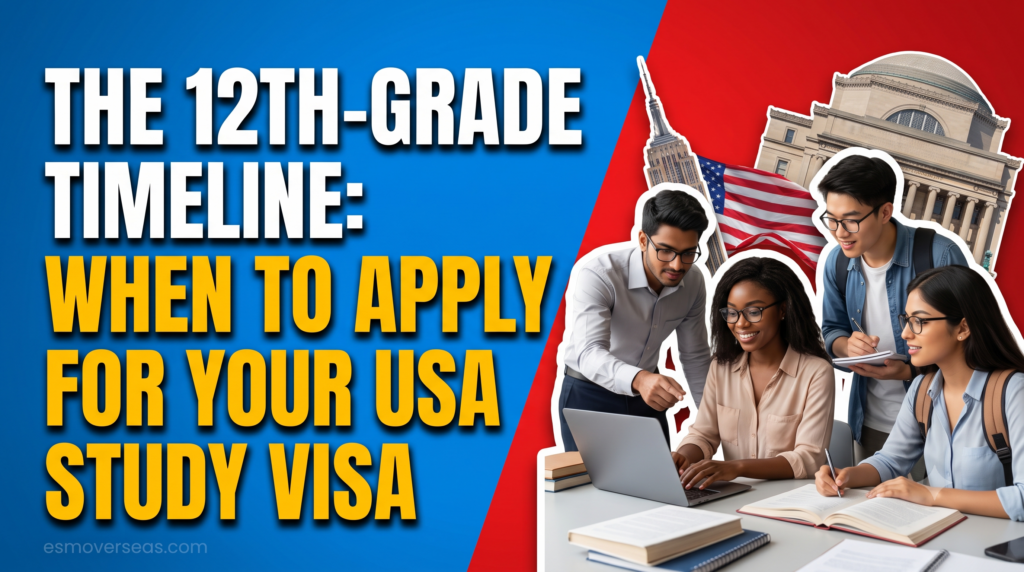
When Should You Apply for a USA Study Visa After 12th Grade?
You should start your USA study visa (F-1) process while you are still in Class 12 — ideally by August–September of Grade 12 for a Fall intake the following year. The actual visa application (DS-160, SEVIS fee, interview) happens 3–4 months before your course start date, but university shortlisting, testing, and applications must begin 12–15 months earlier.
For most Indian students, “when to apply for a US visa” is really two questions rolled into one: when to start the university admissions process, and when to book the actual visa interview. In our experience handling 200+ F-1 visa applications from students across Punjab, Haryana, and Chandigarh at ESM Overseas, the single biggest reason for last-minute panic isn’t a weak profile or a difficult interview — it’s simply starting too late. This article breaks the entire journey down month by month, from the start of Class 12 to the day you board your flight.
Why Timing Your F-1 Visa Application Matters
The US student visa system is not a single event — it’s a chain of dependent steps, and each one has its own waiting period:
- Universities take 6–10 weeks to review applications and release admission decisions.
- The I-20 (your certificate of eligibility for F-1 status) is only issued after you confirm admission and pay a deposit.
- The SEVIS I-901 fee must be paid and processed before you can even fill the DS-160 form.
- US Embassy and consulate interview slots in India — Delhi, Mumbai, Chennai, Kolkata, and Hyderabad — fill up quickly during the April–July “peak season,” when tens of thousands of Indian students are all applying for the same Fall intake.
Miss any one link in this chain and the delay cascades forward. ESM Overseas’ visa experts have seen students with excellent academic profiles lose their intended intake simply because they applied to universities in December instead of September — leaving no cushion for visa interview wait times.
There’s also a psychological cost to poor timing that families often underestimate. When everything is compressed into the last two months before an intake — university deposit, I-20 collection, SEVIS payment, DS-160, document gathering, and interview preparation all happening at once — students walk into their visa interview stressed, under-rehearsed, and more likely to fumble simple questions. A visa officer isn’t just checking your paperwork; they’re also assessing how clearly and confidently you can talk about your own plans. That confidence comes far more naturally when you aren’t racing a deadline.
On the other hand, starting early doesn’t mean starting anxious. It simply means spreading the same set of tasks across 10–12 months instead of 10–12 weeks, so that each step — testing, essays, applications, financial planning, and the visa process itself — gets the attention it deserves without one stage bleeding into the next in a panic.
The Complete 12th-Grade to USA Visa Timeline (Month-by-Month)
Here is the realistic, field-tested timeline we recommend to students who want to start a Bachelor’s program in the USA in the Fall (August/September) session right after Class 12.
| Timeline (Class 12) | What You Should Be Doing | Why It Matters |
|---|---|---|
| June–August (start of Class 12) | Shortlist 8–10 universities, take/register for SAT, ACT, TOEFL, IELTS, or Duolingo English Test | Most competitive US universities need standardized test scores submitted with the application |
| September–November | Draft essays (Common App / university-specific), request LORs from teachers, finalize SOP | Early Decision/Early Action deadlines usually fall between 1 Nov and 15 Nov |
| December–January | Submit Regular Decision applications (most deadlines fall between 1 Jan and 15 Feb) | Missing these deadlines means waiting an entire extra year |
| February (Class 12 boards begin) | Focus on board exams; keep an eye on admission portals for decisions | Most US universities do not require final Class 12 marks before releasing initial admission decisions |
| March–April | Admission offers arrive; compare financial aid/scholarships; confirm one university and pay the enrollment deposit | The I-20 cannot be issued until you formally accept an offer and pay the deposit |
| April–May | Receive your I-20; pay the SEVIS I-901 fee; complete the DS-160 online visa application | This is the official start of your F-1 visa process |
| May–June | Pay the MRV visa fee; book your visa interview slot at the nearest US consulate | Interview slots during peak season can be booked out 3–6 weeks in advance |
| June–July | Attend the visa interview; prepare financial documents, admission proof, and academic records | Most F-1 visas for genuine student profiles are processed within a few days to a few weeks of the interview |
| August | Book flights, arrange accommodation, attend university orientation | US universities usually require arrival 1–2 weeks before classes begin |
Key Takeaway
If you count backward from an August/September Fall intake, the visa process itself (I-20 to interview) takes roughly 8–12 weeks in a normal year — but the university application process that feeds into it needs to start almost a full year in advance. That is why ESM Overseas recommends students begin working with a counsellor at the very start of Class 12, not after boards are over.
What If You’re a Repeater or a Gap-Year Student?
Not every student follows the straight-through-Class-12 path, and that’s completely fine. If you’re repeating Class 12, retaking board exams, or taking a planned gap year to improve test scores, the same month-by-month logic still applies — just shift the entire calendar to match your actual Class 12 (or equivalent) completion year. The one adjustment we recommend: gap-year students should be extra thorough with their financial documentation and SOP, since visa officers sometimes ask more detailed questions about the gap period to understand your continuity of intent to study.
Two-Year Master’s Aspirants: A Slightly Different Clock
This article focuses on the Class 12-to-Bachelor’s pathway, since that’s what most of our younger students and their parents ask about first. If you’re actually planning a Master’s degree after your undergraduate years in India, the same principles hold, but the calendar shifts: GRE/GMAT and English test prep typically begin 14–16 months before intake, applications are usually due between October and January (for a Fall start), and the visa stage still needs its own 8–12 week runway after the I-20 arrives. Many Class 12 students in Punjab and Haryana are already thinking two steps ahead to a US Master’s, and it’s worth knowing that early good habits — organised documentation, disciplined test prep, realistic university shortlisting — carry forward directly into that later application too.
Step-by-Step: How to Apply for Your F-1 Student Visa
Once you have your university admission confirmed and deposit paid, the actual visa process follows these steps:
- Receive your Form I-20 from your university’s international student office. This document carries your unique SEVIS ID number.
- Pay the SEVIS I-901 fee (currently USD 350, roughly ₹33,600 at today’s exchange rate) online at fmjfee.com, using your SEVIS ID from the I-20.
- Complete the DS-160 form — the official online nonimmigrant visa application — on the US Department of State’s CEAC portal. Keep your confirmation barcode number safe; you’ll need it for your interview.
- Pay the MRV visa application fee (currently USD 185, roughly ₹17,760) through the official US visa services portal for India.
- Schedule your visa interview at the US Embassy in Delhi or a consulate in Mumbai, Chennai, Kolkata, or Hyderabad, based on your jurisdiction.
- Prepare your document set: valid passport, I-20, DS-160 confirmation, SEVIS fee receipt, admission letter, academic transcripts and mark sheets, standardized test scorecards, and financial proof (bank statements, education loan sanction letter, or sponsor’s income documents).
- Attend the visa interview. Be ready to speak clearly and honestly about your chosen course, university, career plans, and ties to India.
- Track your passport status and collect your stamped passport once the visa is approved — this typically happens within a few working days for straightforward cases, though administrative processing can occasionally take longer.
USA Study Visa Costs in 2026 (INR & USD)
One of the most common questions we get at our Chandigarh office is simply: “how much will the visa itself cost, apart from tuition?” Here is an honest, itemized breakdown based on current government fee schedules and our clients’ actual spending in 2026.
| Fee/Expense | Amount (USD) | Approx. Amount (INR)* |
|---|---|---|
| SEVIS I-901 Fee | $350 | ₹33,600 |
| MRV Visa Application Fee (DS-160) | $185 | ₹17,760 |
| University application fees (per university, typically 6–8 applied to) | $50–$100 each | ₹4,800–₹9,600 each |
| Standardized tests (IELTS/TOEFL/SAT/ACT, combined) | $250–$400 | ₹24,000–₹38,400 |
| Courier/administrative charges for passport and documents | $10–$20 | ₹960–₹1,920 |
| Total mandatory visa-stage costs (SEVIS + MRV only) | $535 | ≈ ₹51,360 |
*Calculated at an approximate exchange rate of USD 1 = INR 96 (July 2026). Actual INR outflow will vary slightly depending on your bank’s forex conversion rate and card charges on the day of payment. A separate, newly introduced Visa Integrity Fee may apply to certain visa categories in some cases — ESM Overseas’ visa experts confirm the exact, applicable amount for your specific case during your consultation, since eligibility and enforcement have been evolving through 2026.
This does not include tuition and living costs, which vary widely by university and state — typically USD 20,000–45,000 (₹19.2 lakh–₹43.2 lakh) per year for tuition alone at most public and private universities, with community colleges and public universities in lower cost-of-living states often coming in below this range.
Fall vs Spring Intake: Which Timeline Fits You?
Most Class 12 students target the Fall intake, but the Spring intake is a genuine backup option for students who miss key deadlines or want extra time to strengthen their profile.
| Factor | Fall Intake (Aug/Sept) | Spring Intake (Jan) |
|---|---|---|
| University choice | Widest — almost all US universities admit for Fall | Narrower — many top universities do not offer Spring admission for freshmen |
| Scholarship availability | Highest — most merit scholarships are tied to Fall | Limited — fewer scholarship pools open in Spring |
| Application deadline (from Class 12) | Dec–Feb of the same academic year | Sept–Oct of the same year (roughly 3–4 months later than Fall deadlines) |
| Visa interview wait times | Longest — peak season is May–August | Shorter — interview slots are easier to get in Oct–Dec |
| Best suited for | Students who plan early, from the start of Class 12 | Students who decide late, or want to retake tests/improve their profile |
Common Mistakes Students from Punjab & Haryana Make
In our experience handling 200+ applications from Chandigarh, Mohali, Ludhiana, Jalandhar, Panchkula, and surrounding towns, a few patterns repeat every single year:
- Waiting for board exam results before starting university applications. Most US universities evaluate you on Class 11 marks, predicted Class 12 scores, and test scores — not final board results.
- Booking the visa interview too close to the intake date. During peak season (May–July), interview slots at the Delhi Embassy and other consulates can be scarce, and a delay here can push your entire intake back.
- Incomplete or inconsistent financial documentation. Visa officers look closely at the source and stability of funds. Sudden, large, unexplained deposits in a bank account just before the interview are a common reason for refusal.
- Treating the interview as a memorized script. Genuine, confident answers about your course choice and future plans matter far more than rehearsed, generic responses.
- Not budgeting for the full cost picture. Families often plan for tuition but forget SEVIS fees, MRV fees, test costs, and initial living expenses, leading to last-minute scrambling for funds.
- Choosing a university based only on rankings, without checking visa-relevant factors. A university’s affordability, course relevance to your academic background, and its willingness to answer your I-20 queries promptly all affect how smoothly your visa stage goes.
What Visa Officers Are Actually Evaluating
A lot of anxiety around the F-1 interview comes from not knowing what’s actually being assessed. In our experience preparing students for this exact moment, consular officers are primarily checking three things: whether you’re a genuine student with a credible academic plan, whether you have the financial means to fund your first year (and a believable plan for the years after), and whether you have strong enough ties to India — family, property, career plans — that a return after your studies is plausible. Nothing about this requires a rehearsed script. It requires clarity. Students who can explain, in their own words, why they chose their specific course and university tend to do far better than students who recite a memorized paragraph.
A short, honest answer beats a long, polished one almost every time. If you don’t know the exact name of a professor you’ll study under, that’s fine — say so, and talk instead about the program structure or specialization that drew you in. Visa officers interview dozens of students a day; genuine, specific answers stand out.
How ESM Overseas Helps You Stay on Track
At ESM Overseas, we work with Class 11 and Class 12 students right from the university shortlisting stage through to visa stamping — so that no step is left to the last minute. Our visa guidance process includes mock interviews, a full document checklist review, and financial documentation planning tailored to what US consulates in India are currently asking for. Because we handle applications for the USA alongside other popular destinations, we can also help you compare our USA study visa pathway against other countries if you’re still deciding where to apply.
We won’t promise a guaranteed visa outcome — no honest consultant can, since the final decision always rests with the US consular officer. What we can promise is that you won’t miss a deadline, misunderstand a requirement, or walk into your interview underprepared.
Frequently Asked Questions
1. When exactly should a Class 12 student start the US visa process?
Start university shortlisting and test preparation at the beginning of Class 12 (around June–August). The actual visa steps — SEVIS fee, DS-160, interview — begin only after you receive your I-20, typically around March–May.
2. Can I apply for a US student visa before my Class 12 board results are out?
Yes. Most US universities admit students based on predicted or provisional Class 12 marks along with Class 11 results and test scores. Final mark sheets are usually required only after arrival, not before the visa interview.
3. How long does F-1 visa processing take in India in 2026?
Interview wait times vary by consulate and season, often ranging from a few weeks during off-peak months to several weeks longer during the May–August peak season. Once the interview is done, straightforward approvals are typically processed within days, though some cases require additional administrative processing.
4. What is the total mandatory fee for a US student visa?
The two mandatory government fees are the SEVIS I-901 fee (USD 350) and the MRV application fee (USD 185), totaling USD 535, or approximately ₹51,360 at current exchange rates. This does not include university application fees, test fees, or a possible Visa Integrity Fee for certain applicants.
5. What happens if I miss the Fall intake deadlines?
You can apply for the Spring intake (January), though university and scholarship options are more limited. It’s a genuine backup, not a failure — many strong students use the extra months to retake tests or strengthen their SOP.
6. Do I need to show a fixed deposit or can an education loan be used as financial proof?
Both are accepted. A sanctioned education loan letter from an Indian bank, along with proof of collateral where applicable, is commonly used and generally well understood by visa officers, alongside personal savings or sponsor income documentation.
7. Is it better to apply to fewer universities or more?
ESM Overseas’ visa experts generally recommend 6–8 universities across a realistic mix of ambitious, moderate, and safe options, rather than applying to 15+ universities, which increases costs without meaningfully improving outcomes.
8. Can ESM Overseas help if I’m already behind on my timeline?
Yes. While earlier is always better, we’ve helped many students compress the process when they’ve started late — including guiding them toward universities with rolling admissions or a realistic Spring intake plan.
Let’s Build Your Timeline Together
Every student’s situation is a little different — your target course, your budget, and how far along you already are all change what your ideal timeline looks like. Rather than guessing, talk it through with someone who does this every day.
We offer a free, no-pressure 15-minute consultation to map out your personal USA study visa timeline, whether you’re just starting Class 12 or already sitting on an admission offer.
- Call or WhatsApp: +91-7087217801
- Visit us at: SCO 375-376, Sector 35B, Chandigarh
- Contact ESM Overseas online for more details
There’s no obligation and no hard sell — just an honest conversation about what your next few months should look like.