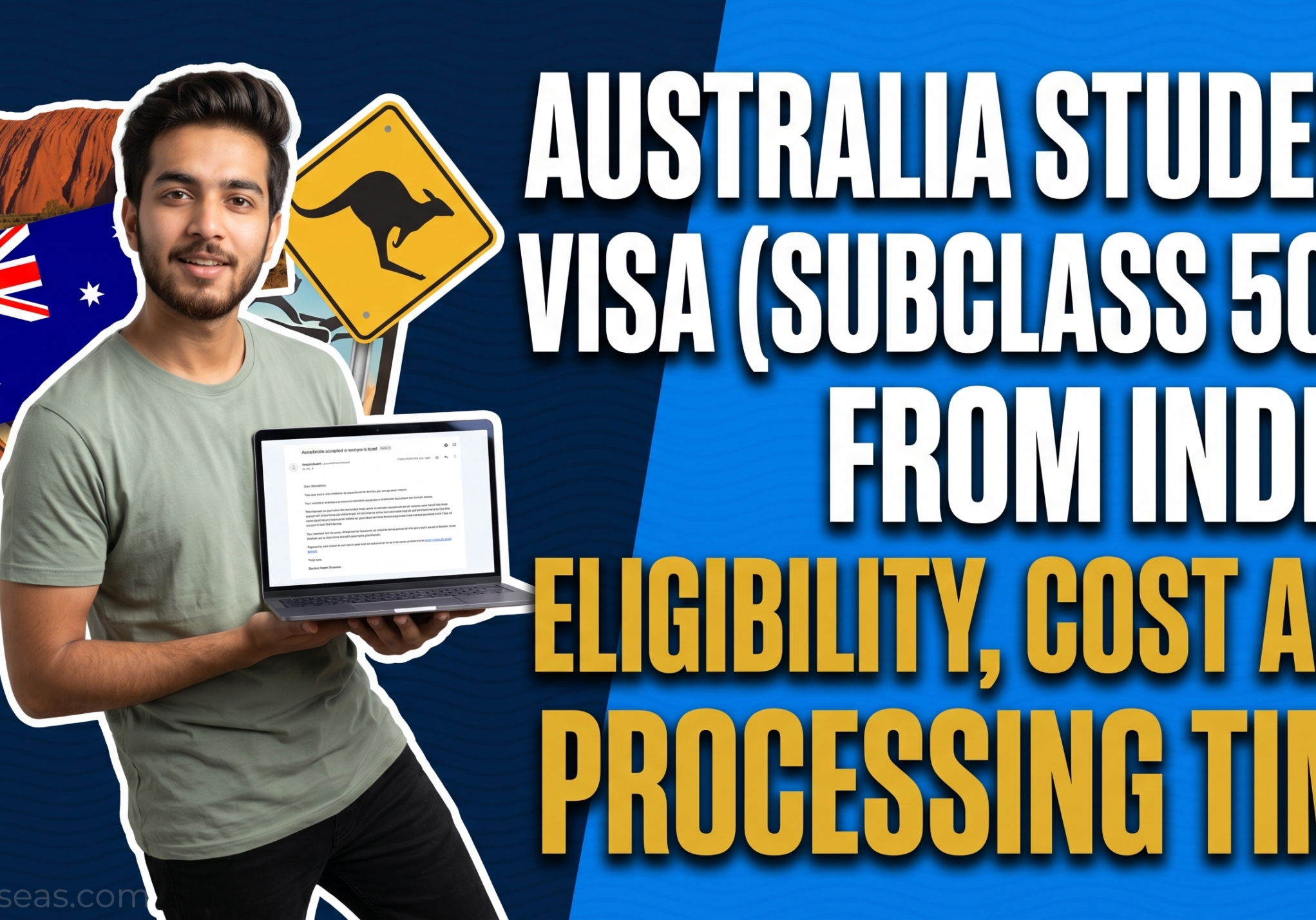
Australia Student Visa (Subclass 500) from India: Eligibility, Cost and Everything You Need to Know Before You Apply
By ESM Overseas Visa Experts | Updated June 2026
⏱️ 17 min read · 3,316 words
What’s Inside This Guide
- What Is the Australia Student Visa Subclass 500?
- Eligibility: Who Can Apply for the Subclass 500 Visa?
- What Does the Australia Student Visa Cost from India? (Full Breakdown in INR)
- Australia Student Visa Processing Time: What to Realistically Expect
- Step-by-Step: How to Apply for the Subclass 500 Visa from India
- What Most People Get Wrong About the Subclass 500 Application
- For Parents: What You Need to Know (Share This With Your Family)
- Frequently Asked Questions About Australia Subclass 500 Student Visa
You got your offer letter from a university in Melbourne or Sydney. Your family is excited. You’ve already started imagining life in Australia. And then someone says: “Have you sorted the student visa yet?” — and suddenly that excitement turns into a quiet panic.
We get it. The Australia student visa subclass 500 sounds simple on paper, but when you start reading the official guidelines, it feels like you need a law degree just to understand the checklist. Between the Genuine Student requirement, OSHC insurance, proof of funds, and processing timelines, it’s easy to feel lost before you’ve even started.
This guide is written for students from Punjab, Haryana, and Chandigarh who are applying for the first time. No jargon. No guesswork. Just a clear, honest breakdown of what you actually need — with real numbers, real timelines, and real mistakes to avoid.
At a Glance: Australia Subclass 500 Student Visa
- Visa fee: AUD 710 (approx. ₹39,000)
- OSHC (health cover): AUD 670–900/year (approx. ₹37,000–₹50,000)
- Proof of funds required: AUD 21,041/year living costs + full tuition + travel
- Processing time: 4 to 8 weeks (can go up to 12 weeks in peak season)
- IELTS minimum: 5.5–6.5 overall (depends on institution)
- GS requirement: Must prove you are a Genuine Student with real academic goals
- Work rights: Up to 48 hours per fortnight during term (unlimited during breaks)
- Valid for: Duration of your course + extra buffer period
What Is the Australia Student Visa Subclass 500?
The Australia student visa subclass 500 is a temporary visa that allows international students to live, study, and work part-time in Australia while enrolled in a registered full-time course. It replaced the older student visa categories and now covers everything from undergraduate and postgraduate degrees to vocational training (TAFE) and English language programs at registered CRICOS providers.
You apply for it online through the Australian Department of Home Affairs portal, and it is valid for the entire duration of your enrolled course — including a grace period after you finish.
What makes it different from other country visas is the Genuine Student (GS) requirement — a relatively new assessment framework (introduced in March 2024) that replaced the older Genuine Temporary Entrant (GTE) test. More on that below, because this is where most Indian students get tripped up.
Eligibility: Who Can Apply for the Subclass 500 Visa?
To be eligible for the Australia student visa subclass 500, you need to meet several core requirements. Let’s break each one down plainly:
1. Enrolment in a CRICOS-Registered Course
Your institution and your specific course must be registered on the Commonwealth Register of Institutions and Courses for Overseas Students (CRICOS). If you received an offer letter from a university or TAFE — institutions like the University of Melbourne, RMIT, Monash, or any recognised provider — they will already be CRICOS-registered. Always verify this before you pay your tuition deposit.
2. Genuine Student (GS) Requirement — The Most Important One
This is the requirement that has changed the most since 2024, and it deserves your full attention.
The Genuine Student requirement asks you to demonstrate that your primary purpose in going to Australia is to study — not to migrate, not to work, not to use the student visa as a stepping stone to a permanent residence pathway. A visa officer will assess this based on your personal circumstances, your academic background, your career plans, and how your chosen course aligns with your goals.
According to ESM Overseas’ visa experts, students who struggle most with the GS requirement are those who cannot clearly articulate why this course, why Australia, and why now. A Chandigarh student applying for a Bachelor’s in Information Technology after completing Class 12 Science with strong marks will generally have a straightforward case. But a student who studied Commerce up to graduation and is now suddenly applying for a Master’s in Cybersecurity — without explaining the career shift — may face additional scrutiny.
The GS statement you submit (typically a Personal Statement or Statement of Purpose) should cover:
- Your educational background and what you studied so far
- Why this specific course aligns with your career goals
- Why you chose Australia and this particular institution
- Your plans after completing the degree (return to India or explore Australian post-study pathways legally)
- How your family supports this decision financially
3. English Language Proficiency
Most institutions require a minimum IELTS Academic score of 6.0–6.5 overall (no band below 5.5 or 6.0 depending on the course). Some vocational or foundation programs accept 5.5 overall. Check your specific institution’s requirements — they vary. PTE Academic and TOEFL iBT are also accepted alternatives.
4. Financial Capacity
You must demonstrate that you have enough funds to cover:
- Your full tuition fees for the first year
- Living expenses: AUD 21,041 per year (official 2025–26 figure, approximately ₹11.5 lakh)
- Return airfare: approximately AUD 2,000 (approx. ₹1.1 lakh)
- School fees for any dependants you bring along
The funds can be shown through bank statements, Fixed Deposits, or a combination of both — ideally in your name, your parents’ name, or a guardian who is sponsoring your education. In our experience with 200+ Australia student visa applications, funds should be seasoned for at least 3–6 months in the bank before you apply. A sudden large deposit a week before the application is a red flag for visa officers.
5. Health and Character Requirements
You will need to undergo a medical examination conducted by a DIBP-approved panel physician (available in Delhi, Mumbai, Chennai, and a few other cities). Most students from Punjab and Chandigarh travel to Delhi for this. You must also provide a police clearance certificate if requested.
What Does the Australia Student Visa Cost from India? (Full Breakdown in INR)
One of the biggest worries families have is: “How much money are we actually spending before the student even lands in Australia?” Let’s put every cost on the table.
| Cost Component | Amount (AUD) | Approx. Amount (INR) | Paid To |
|---|---|---|---|
| Visa application fee | AUD 710 | ₹39,000 | Australian Dept. of Home Affairs |
| OSHC (health cover, 1 year) | AUD 670–900 | ₹37,000–₹50,000 | OSHC provider (Bupa, Medibank, etc.) |
| Medical exam | AUD 300–350 | ₹16,500–₹19,500 | Approved panel physician |
| Police clearance certificate | — | ₹500–₹1,000 | Local police / Govt. portal |
| Document translation (if needed) | — | ₹3,000–₹8,000 | Certified translator |
| IELTS exam (if not yet taken) | — | ₹17,000 | British Council / IDP |
| Total pre-departure visa costs | — | ₹1.13 lakh – ₹1.35 lakh | — |
Important: The INR figures above are approximations based on June 2026 AUD/INR exchange rates (~₹55 per AUD). Exchange rates fluctuate — always check the rate at the time of your actual payment.
A student from Ludhiana with a family income of 10 LPA, applying for a Master’s degree in Adelaide, would typically need to show approximately ₹25–30 lakh in accessible funds (tuition + living costs for the first year + buffer) to satisfy the financial requirement comfortably.
Australia Student Visa Processing Time: What to Realistically Expect
This is the question we get most often at our Chandigarh office: “How long will the visa take?” The honest answer is — it depends, but here is what the data actually shows.
As of June 2026, the Australian Department of Home Affairs publishes indicative processing times on their official website:
- 75% of applications are processed within 6 weeks
- 90% of applications are processed within 10 weeks
- Complex cases (additional document requests, medical delays, GS concerns) can take 12–16 weeks
Peak application periods — typically April to June and October to November — see longer delays as officers process a surge of applications for July and February intakes. If your course starts in July 2026, you should ideally submit your visa application no later than March or April.
According to ESM Overseas’ visa experts, the single biggest cause of processing delays for Indian applicants is an incomplete or unclear GS statement and missing financial documentation. Applications that go in complete, well-organised, and with a strong personal statement move significantly faster.
Step-by-Step: How to Apply for the Subclass 500 Visa from India
- Receive your Confirmation of Enrolment (CoE): Once you accept your institution’s offer and pay the tuition deposit, you’ll receive a CoE — a unique electronic reference number you’ll need for your visa application.
- Purchase OSHC: Before you apply for the visa, you must arrange Overseas Student Health Cover for the duration of your stay. Your institution may arrange this for you, or you can purchase it independently from providers like Bupa, Medibank, or Allianz. Make sure it starts from your visa commencement date.
- Create an ImmiAccount: Go to the Australian Department of Home Affairs website and create an ImmiAccount. All applications are submitted here — there is no paper application for the Subclass 500.
- Gather your documents: This includes your passport, CoE, OSHC certificate, IELTS/PTE scorecard, academic transcripts, financial evidence (bank statements, FD certificates), and your Genuine Student personal statement.
- Complete the medical examination: Book with an approved panel physician. In North India, panel physicians are available in Delhi (multiple clinics), Chandigarh (limited options), and Amritsar. Book early — popular clinics fill up 2–3 weeks in advance during peak season.
- Submit your application online: Upload all documents through ImmiAccount and pay the AUD 710 visa fee. You’ll receive an acknowledgement email immediately.
- Biometrics (if requested): Some applicants may be asked to provide biometrics at a VFS Global centre. This is not required for everyone.
- Await the decision: Track your application through ImmiAccount. If the department needs additional information, they’ll email you a section 46 or section 57 request — respond promptly and completely.
What Most People Get Wrong About the Subclass 500 Application
In our experience helping hundreds of students from Punjab, Haryana, and Chandigarh apply for Australian student visas, we see the same mistakes come up again and again. Avoiding these alone can be the difference between approval and rejection.
Mistake 1: Treating the GS Statement as a formality
Many students write a generic two-paragraph statement that says “I want to study in Australia to improve my career prospects.” This is not enough. Visa officers are trained to spot vague, copy-paste statements. Your GS statement must be personal, specific, and logically connect your past, your course choice, and your future plans. A student from Mohali applying for a Master’s in Environmental Engineering should explain what projects or work experiences drew them to this field — not just that “Australia is a great country for education.”
Mistake 2: Showing funds at the last minute
Depositing ₹30 lakh into a savings account two weeks before the visa application is a pattern visa officers flag immediately. Funds should be in place and seasoned — ideally 3 to 6 months before application date. Fixed Deposits opened months earlier carry much more weight than a fresh bank deposit.
Mistake 3: Applying too close to the course start date
With processing times of 6–10 weeks and potential delays, applying 4–5 weeks before your course starts is a gamble. Apply at least 10–12 weeks in advance. If your course starts in July, your application should be in by April at the latest.
Mistake 4: Ignoring OSHC or buying minimal cover
OSHC is not optional — it is a visa condition. Buying cover only for the initial few months to save money, and then assuming you’ll extend it later, is a common shortcut that creates problems. Your OSHC must cover your entire stay, including your grace period after course completion.
Mistake 5: Choosing a course just because it’s cheaper
If your course choice does not align logically with your academic history or stated career goals, the GS assessment will flag it. A student who studied Humanities and is now applying for a Diploma in Automotive Engineering purely because tuition fees are lower will face tough questions. Authenticity matters more than cost optimization when it comes to course selection.
For Parents: What You Need to Know (Share This With Your Family)
If your son or daughter has shared this article with you, here is what matters most from a parent’s perspective — written in plain language, no visa jargon.
The visa process is straightforward if done correctly. Australia’s student visa system is well-structured and transparent. The biggest risks come not from the process itself but from incomplete paperwork, weak personal statements, or applying too late. With the right guidance, approval rates for well-prepared applications are very high.
Your financial documents matter as much as your child’s marks. The visa officer will look at your bank statements, Fixed Deposits, and income sources to confirm that your family can genuinely support your child’s education abroad. Joint bank accounts, salary slips, and IT returns from the last 2–3 years are all helpful. There is no single “minimum amount” rule — the officer looks at the complete picture of your financial stability.
Your child can work in Australia during studies. As of June 2026, Subclass 500 visa holders can work up to 48 hours per fortnight during academic term, and unlimited hours during official breaks. This is not a replacement for your financial support but can help cover day-to-day living expenses.
Health cover is mandatory and comprehensive. OSHC covers your child for hospital visits, doctor consultations, limited dental, and emergency care. It is not the same as Indian health insurance — it is specifically designed for international students in Australia and is a visa requirement, not an optional add-on.
If you have questions that this article doesn’t answer, our team at ESM Overseas is available at +91-7087217801. We work directly with parents as well as students — because a family decision deserves a family conversation. We offer study visa consultancy in Chandigarh that covers every step of this process from shortlisting to submission.
Frequently Asked Questions About Australia Subclass 500 Student Visa
1. How much bank balance is needed for an Australia student visa from India?
There is no single fixed amount, but as a practical guideline, you need to demonstrate funds covering your first year’s tuition fees, plus AUD 21,041 (approximately ₹11.5 lakh) in living expenses, plus approximately AUD 2,000 (₹1.1 lakh) for travel. For a course with AUD 25,000 annual tuition, you’re looking at showing approximately ₹22–25 lakh in accessible funds. Fixed Deposits, savings accounts, and parents’ accounts can all be combined to meet this requirement.
2. How long does the Australia student visa take to process from India?
As of June 2026, 75% of applications are decided within 6 weeks and 90% within 10 weeks. However, during peak periods like April–June and October–November, processing can take 12–14 weeks. Always apply at least 10–12 weeks before your course start date to give yourself a safe buffer. Applications with complete documentation and strong GS statements typically move faster.
3. What is the Genuine Student (GS) requirement and how does it affect my visa?
The Genuine Student requirement replaced the GTE test in March 2024. It is an assessment by the visa officer of whether your primary motivation for going to Australia is genuinely to study. You must submit a personal statement explaining why you chose this specific course and institution, how it connects to your career goals, and what your plans are after graduation. A weak or generic GS statement is the most common reason for delays and refusals for Indian applicants.
4. Can I work while studying in Australia on a Subclass 500 visa?
Yes. Subclass 500 visa holders can work up to 48 hours per fortnight while school is in session, and unlimited hours during official holiday periods. This is enough to cover some living costs — a part-time job in retail, hospitality, or delivery typically pays AUD 24–28 per hour (above minimum wage). However, work rights should not replace your primary financial proof during the visa application.
5. What IELTS score is required for an Australia student visa?
The IELTS requirement depends on your institution and course, not just the visa. Most undergraduate and postgraduate programs require an IELTS Academic score of 6.0–6.5 overall with no individual band below 5.5 or 6.0. Some TAFE or vocational programs accept 5.5 overall. The visa itself does not set a specific minimum — your institution’s offer letter sets the benchmark, and if you meet that, the visa will generally accept it. Some students may also be asked to take an English language test during the visa process if their scores are borderline.
6. Is OSHC mandatory, and what does it cover?
Yes, Overseas Student Health Cover is mandatory for all Subclass 500 visa holders for the entire duration of their course. It covers hospital care, GP visits, limited pharmaceutical costs, and emergency treatment. Annual premiums range from AUD 670 to AUD 900 depending on the provider and whether you include extras cover. Your university may organise OSHC on your behalf — check your offer letter. You cannot enter Australia on a student visa without valid OSHC in place from your visa start date.
7. Can my parents visit me in Australia while I’m studying?
Yes, your parents can apply for an Australian Tourist Visa (Subclass 600) to visit you while you are studying. They are separate applications from your student visa. For families from Punjab and Chandigarh, the Visitor visa for parents visiting a student child is generally viewed favourably when properly documented — showing your enrolment, accommodation, and their financial ability to support their own travel costs. Our team can assist with visa guidance services for family visitor applications as well.
8. What happens if my Australia student visa is refused?
A refusal is not the end of the road. You can either apply again (after addressing the reasons for refusal) or appeal through the Administrative Appeals Tribunal (AAT) within a specific time window after the decision. The most common reasons for refusal are: insufficient financial evidence, a weak Genuine Student statement, incomplete documents, or a course that does not align logically with your academic history. If you receive a refusal, do not reapply immediately — take time to understand the specific reason and address it fully. Our team at ESM provides detailed financial planning help and document review to strengthen reapplication cases.
If you’ve read this far, you’ve just absorbed more about the Australia student visa than most applicants know going in. And yes — it is a lot. Between the GS statement, the financial proof, the OSHC, the medical, and the timeline management, there are genuinely many moving parts. Feeling overwhelmed at this stage is completely normal and does not mean you’re not ready.
Here’s what we’ve seen work best after helping 200+ students through this process: the students who get their visas on the first attempt are not necessarily the ones with the highest IELTS scores or the most money in the bank. They’re the ones who applied with a clear story, complete documents, and enough time on their side.
You’ve done the research. The next step is a 15-minute conversation with someone who has guided hundreds of students through this exact process. No pressure — just clarity on YOUR specific situation, YOUR financial picture, and YOUR timeline.
Book a free consultation: +91-7087217801
Or visit us at SCO 375-376, Sector 35B, Chandigarh
Or book a free consultation online at esmoverseas.com/contact-us/
We’ll help you figure out exactly what you need — and nothing more.