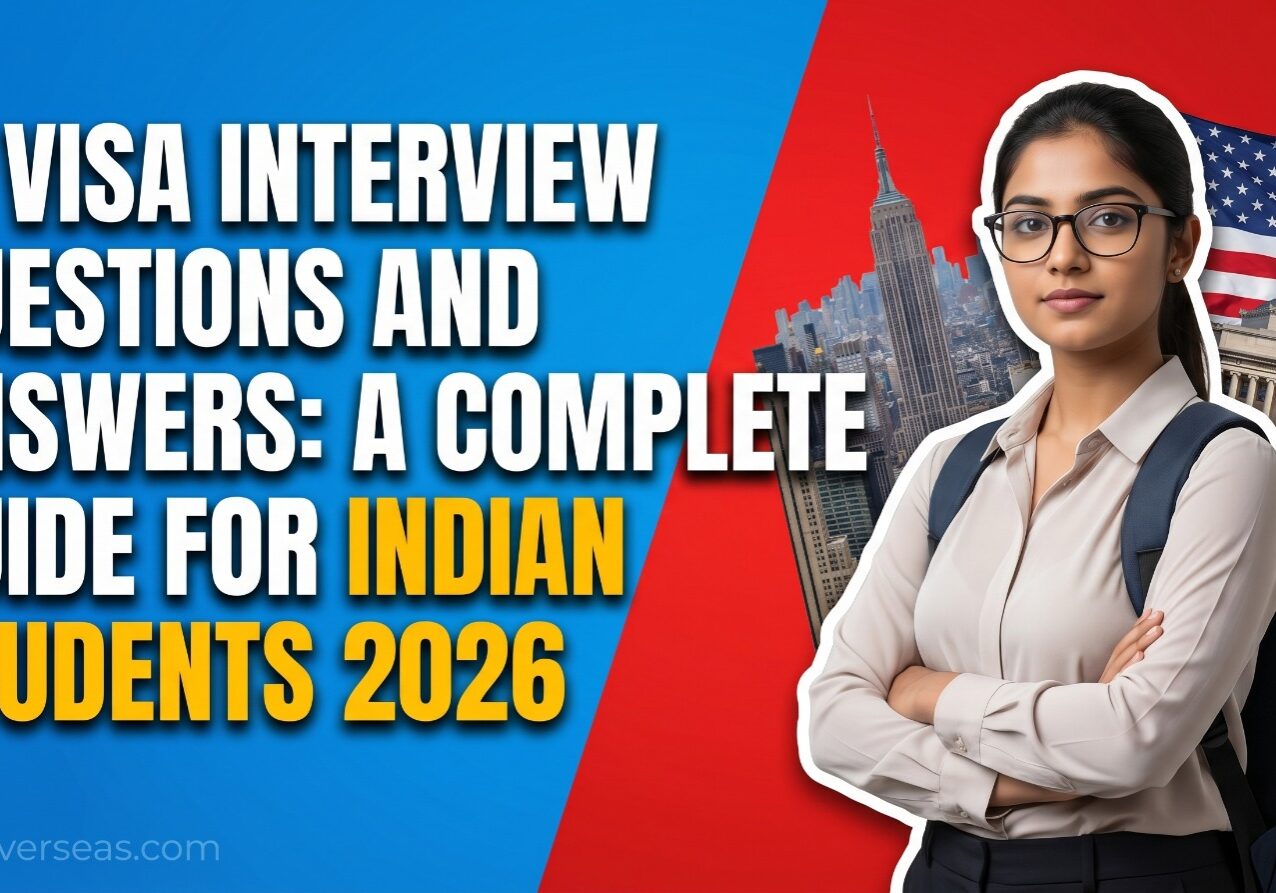
F1 Visa Interview Questions and Answers: A Complete Guide for Indian Students 2026
By ESM Overseas Visa Experts | Updated June 2026
⏱️ 17 min read · 3,240 words
What’s Inside This Guide
- F1 Visa Interview Questions: What You’re Actually Being Assessed On
- The Quick Checklist: What You Need Before the Interview
- Study Plan Questions: The First Thing They’ll Ask You
- Financial Questions: The Part That Scares Families the Most
- Ties to India Questions: The Most Critical Part of Your Interview
- What Most Students Get Wrong: The 7 Interview Mistakes
- A Section for Parents: What You Need to Know Before Your Child’s Interview
- New Delhi vs. Mumbai vs. Chennai: Does the Consulate Location Matter?
- Step-by-Step: What Happens on Interview Day
- Frequently Asked Questions: F1 Visa Interview
Your US acceptance letter just arrived. You’ve spent months writing SOPs, chasing transcripts, and refreshing your email at midnight. Now the US Embassy in New Delhi — or the Consulate in Mumbai, Chennai, or Hyderabad — wants a 3-minute conversation that will decide everything.
That 3-minute F1 visa interview terrifies more students than the GRE ever did. And honestly? We understand why. You’ve never done this before. The visa officer sits behind thick glass. You don’t know what they’ll ask. You’ve heard horror stories from seniors who got rejected despite a full scholarship.
But here’s the truth we tell every student who walks into our office at SCO 375-376, Sector 35B, Chandigarh: the F1 visa interview is not a test of your intelligence. It’s a conversation about your intent. And that is something you can absolutely prepare for.
In this guide, we’re breaking down every real F1 visa interview question — the ones students actually get asked — along with what strong answers look like versus the answers that get applications rejected. We’ll cover study plans, finances, ties to India, and the specific mistakes Indian students from Punjab and Haryana make that you should avoid.
Let’s get into it. If you’re planning to study in USA, this is the most important 15 minutes of reading you’ll do before your interview.
F1 Visa Interview Questions: What You’re Actually Being Assessed On
The F1 visa interview is a structured conversation where the consular officer is trying to answer one question: Will this student leave the US after completing their degree? Every question they ask traces back to this.
According to ESM Overseas’ visa experts, the officer typically covers four themes in this order: your study plans, your financial situation, your ties to India, and your post-study intentions. Understanding this structure changes how you prepare — you stop memorising scripts and start building a consistent story.
The interview usually lasts between 2 and 5 minutes. Officers at Chandigarh-area applicants’ most common interview locations — New Delhi and Mumbai — are known to be direct and fast-paced. They will not wait for you to gather your thoughts.
The Quick Checklist: What You Need Before the Interview
- ✅ Valid DS-160 confirmation page (printed)
- ✅ Original I-20 from your US university
- ✅ SEVIS fee receipt (I-901, paid at least 3 days before)
- ✅ Visa fee payment receipt (MRV fee — currently $185 USD / approx ₹15,400)
- ✅ Valid passport (6+ months validity beyond program end date)
- ✅ Passport-size photos (2×2 inch, white background)
- ✅ Original admission letter + I-20
- ✅ Financial documents: bank statements (last 6 months), ITR, FD certificates, property papers
- ✅ Academic transcripts, degree certificates, IELTS/TOEFL scorecard
- ✅ GRE/GMAT scorecard (if applicable)
- ✅ Scholarship letter (if applicable)
Screenshot this checklist and share it in your family WhatsApp group. Many rejections happen because of missing documents that could have been arranged in 48 hours.
Study Plan Questions: The First Thing They’ll Ask You
These questions come first and set the tone for the entire interview. Your answers here need to be sharp, specific, and confident.
Common Questions in This Category
- “Why did you choose this university?”
- “Why this specific course/program?”
- “Who will pay for your education?”
- “Why not study in India?”
- “Did you apply to other universities?”
Strong vs. Weak Answers
| Question | Weak Answer ❌ | Strong Answer ✅ |
|---|---|---|
| “Why this university?” | “It has good rankings and nice campus.” | “Professor Dr. Sarah Kim’s research in machine learning systems aligns directly with my final-year project at Thapar University. Their co-op program also means I get 12 months of industry experience before I graduate.” |
| “Why not study in India?” | “US education is better.” | “The specific combination of AI and supply chain logistics I want to study isn’t offered at this depth in Indian universities. The US program also connects to the exact industry I want to work in — back in India — after completing my degree.” |
| “Did you apply elsewhere?” | “Yes, many places.” | “I applied to four universities. I chose this one because of the funding package and the specific faculty. I turned down two other acceptances to come here.” |
In our experience with 200+ F1 visa applications, the single most common reason for rejection in the study-plan section is vague answers. Officers have heard “good university, good future” ten thousand times. They want to hear your specific reason.
Financial Questions: The Part That Scares Families the Most
This is where families from Punjab and Haryana — often funding education through a mix of savings, property, and loans — feel most anxious. The good news: the officer doesn’t expect you to be rich. They want to see that your funding is legitimate, stable, and sufficient.
Common Financial Questions
- “Who is sponsoring your education?”
- “What is your father’s/family’s annual income?”
- “Do you have an education loan?”
- “How much does your program cost per year?”
- “How will you manage living expenses in the US?”
What Counts as Sufficient Funding in June 2026?
A typical MS program in the US costs between $25,000–$50,000 USD per year (approximately ₹20–42 lakh). For a 2-year program, you’re looking at ₹40–85 lakh in total. Your financial documents should demonstrate the ability to cover this — whether through income, savings, fixed deposits, or a sanctioned education loan.
Real scenario: A student from Mohali with family income of 8 LPA went into the interview worried her finances weren’t strong enough. But her family had ₹25 lakh in FDs, a sanctioned education loan of ₹30 lakh from SBI, and a partial scholarship of $8,000 from the university. When she presented this as a combined package — ₹55 lakh total coverage for a ₹50 lakh program — the officer was satisfied in under 90 seconds.
Key principle: Don’t hide the loan. Officers know most Indian families use education loans — it’s normal and legal. What they’re checking is whether the loan is real (sanctioned, not just applied for) and whether the family has enough assets to back it.
Documents That Build Confidence
- Bank statements showing consistent balance (not a sudden deposit right before the interview)
- Last 3 years of Income Tax Returns
- Sanction letter for education loan (not just the application)
- Property documents or FD receipts
- Scholarship letter from the university (if applicable)
If you need structured help putting your financial story together, our document preparation support team has guided hundreds of families through exactly this.
Ties to India Questions: The Most Critical Part of Your Interview
This is what the interview is really about. The officer’s job is to determine whether you’re a student who will return home after your degree — or someone who intends to overstay. Everything you say about your family, career plans, and India connections feeds into this assessment.
Common “Ties to India” Questions
- “Do you plan to return to India after your studies?”
- “What will you do after your degree?”
- “Do your parents work in India?”
- “Do you own property or have family assets in India?”
- “Do you have siblings in India?”
How to Answer Without Sounding Scripted
The biggest mistake students make here is giving an answer that sounds rehearsed: “Yes sir, I will definitely come back to India after my degree, India is my home.” Officers hear this constantly. It means nothing without substance.
Instead, anchor your ties in specifics:
- Family: “My parents run a business in Ludhiana. My mother’s health means I’m the primary family contact. I won’t be moving abroad permanently.”
- Career plan tied to India: “The data analytics skills I’m learning are for the Indian e-commerce market. Companies like Meesho and Nykaa are hiring for exactly this role in Bangalore — that’s where I’m targeting.”
- Property/business: “My father has agricultural land in Ropar and a transport business. There’s no reason for me to stay in the US — my future is here.”
- Job offer/return plan: “I’ve already spoken to two Chandigarh-based IT firms about post-MS roles. The OPT period lets me gain international experience before returning.”
You don’t need all four. One or two specific, honest ties are far more convincing than a generic promise to return.
What Most Students Get Wrong: The 7 Interview Mistakes
According to ESM Overseas’ visa experts, these are the errors we see most often — and they are entirely avoidable with the right preparation.
- Memorising answers word-for-word. Officers ask follow-up questions. If you’ve memorised a script, you freeze when they go off-script. Understand your story instead.
- Not knowing your DS-160 form. Every answer you give must align with your DS-160. If your DS-160 says you’re applying to study Computer Science and you say “data science” in the interview, the officer notices.
- Bringing unofficial documents. Everything must be original — not photocopied, not scanned. Bank statements must have the bank stamp. ITRs must be official copies.
- Hesitating on financial questions. If your father earns 12 LPA and you pause on this, it looks suspicious. Know your numbers cold before you walk in.
- Over-explaining. Officers are interviewing hundreds of people. Answer in 2-3 sentences. If they want more, they’ll ask. Monologues make them impatient.
- Saying you don’t know the cost of your program. You are about to spend ₹40–80 lakh on education. Knowing what it costs is the bare minimum of seriousness.
- Looking nervous without knowing your own application. Nervousness is normal — but not knowing your own university name, program name, or start date makes it look like fraud.
A Section for Parents: What You Need to Know Before Your Child’s Interview
If you’re a parent from Punjab or Haryana whose child is preparing for the F1 interview, here’s what matters most from your side:
- Your bank statements must show consistent balance. A sudden deposit of ₹20 lakh two weeks before the interview is one of the top red flags officers are trained to spot. Maintain funds consistently for at least 3 months prior.
- Your ITR should match your stated income. If your son or daughter says you earn 15 LPA, but your ITR shows 6 LPA — that’s a problem. Get these aligned before the interview.
- An education loan is not a weakness. A sanctioned SBI, HDFC, or Axis Bank loan with property collateral is strong evidence of genuine intent to study, not overstay.
- You do not attend the interview. F1 interviews are individual. You cannot go in with your child. What you can do: make sure they know your income, your assets, and your family situation well enough to answer clearly.
- Cost: The MRV visa application fee is $185 USD (approx ₹15,400 as of June 2026), paid online before scheduling. The SEVIS I-901 fee is $350 USD (approx ₹29,000). These are non-refundable regardless of outcome.
New Delhi vs. Mumbai vs. Chennai: Does the Consulate Location Matter?
Students from Chandigarh, Ludhiana, Amritsar, and the Tricity area are assigned to the US Embassy in New Delhi. Here’s what you should know about the New Delhi location specifically:
- New Delhi processes a very high volume of F1 applications from Punjab, Haryana, and Himachal Pradesh. Officers are experienced with the region’s typical student profiles.
- Interview slots at New Delhi can book up 6–8 weeks in advance during peak season (June–August). Book your slot as soon as your I-20 arrives.
- New Delhi has a reputation for being thorough on financial verification — especially for students with education loans above ₹30 lakh. Have every document in original.
- Dress formally. Business casual at minimum. Many officers take first impressions seriously.
- Arrive 30 minutes early. You will go through security checks. There is no phone use inside.
Step-by-Step: What Happens on Interview Day
- Arrive at the Embassy/Consulate. Bring all documents in a clear file. No bags with zippers or locks — they’re not allowed inside. Keep your phone off.
- Security check. ID verification, document scan, fingerprinting. This takes 15–30 minutes depending on the queue.
- Document submission window. A staff member reviews your documents before you meet the officer. Have everything in the order above.
- Wait for your interview number. You’ll be called to a window. The officer is behind glass. Speak clearly — not too fast, not too slow.
- The interview begins. 2–5 minutes. Answer directly. Look at the officer. Don’t look at your documents while answering — know your answers.
- Decision communicated. If approved, the officer will say your visa is approved and your passport will be returned by courier within 3–5 working days. If additional documents are needed, you’ll be given a form. If rejected, they’ll tell you the reason under the applicable INA section.
- Collect your passport. After approval, your visa-stamped passport arrives by courier. Check the visa dates, name spelling, and university name immediately upon receipt.
Frequently Asked Questions: F1 Visa Interview
How much bank balance is needed for a USA student visa in 2026?
There’s no fixed minimum, but your family’s financial documents should cover at least the first year’s tuition and living expenses — typically ₹25–45 lakh depending on the university and city. Officers look at the combination of savings, income, and any education loan together, not just your bank balance alone. A family in Chandigarh with ₹12 lakh in savings but a sanctioned ₹35 lakh SBI loan and consistent ITR of 10 LPA is in a strong position. Avoid large unexplained deposits made just before the interview.
What happens if my F1 visa is rejected? Can I apply again?
Yes, you can apply again — there’s no mandatory waiting period after most rejections, though you should wait until you have genuinely new or improved information to present. The most common rejection reason is Section 214(b) — insufficient ties to India. If you’re rejected under this, revisit your “ties to India” narrative, strengthen your financial documents, and consider whether your career plans back in India are specific enough. In our experience, students who are rejected with good documentation get approved on a second attempt more than 60% of the time when they address the root cause.
Do I need to speak perfect English for the F1 interview?
No. Clear, confident communication matters far more than perfect grammar. You’ve already proven your English through IELTS or TOEFL — that’s the language proof the officer needs. Speak at a natural pace, make eye contact, and don’t switch to Hindi even if you’re nervous. If you don’t understand a question, it’s acceptable to politely ask the officer to repeat it once. Avoid over-using filler words like “basically” or “actually” repeatedly — it signals rehearsed answers.
Can my parents come with me to the F1 visa interview?
Parents can accompany you to the Embassy premises, but only the applicant goes into the interview room. The interview is individual. If your parents are the financial sponsors, they do not need to be present — their documents (bank statements, ITR, loan sanction letters) speak for them. Some students find it helps to have parents wait outside simply for emotional support after what can be a nerve-wracking morning.
How early should I schedule my F1 visa interview?
Schedule immediately after receiving your I-20 from the university. During peak months (May through August), New Delhi interview slots can be 6–8 weeks out. You need to pay your SEVIS I-901 fee ($350 USD) at least 3 business days before the interview. Build in time for document preparation and a mock interview session. Ideally, you should be scheduling 8–10 weeks before your program start date — which means starting the moment your I-20 lands in your inbox.
What is the DS-160 and does it affect my interview?
The DS-160 is your online non-immigrant visa application form — every answer you give in the interview must be consistent with what you submitted in this form. Officers can and do cross-reference your verbal answers against your DS-160 data. Fill it carefully and keep a printed copy to review the night before your interview. Common mismatches that cause problems: your travel history, your previous visa applications, your stated purpose of travel, and your employment history. If you find an error in your submitted DS-160, you can resubmit a corrected version before your interview appointment.
Will they ask about my plans after my degree — and what should I say?
Yes, this is almost certain. The safest honest answer ties your post-degree plan specifically back to India. “I want to work in X sector in Bangalore / Chandigarh / Pune, and my program gives me the exact skills for that” is far stronger than “I’ll see what opportunities come.” You can mention OPT (Optional Practical Training) — it’s a legal part of the F1 visa and officers know it exists. But you should frame it as gaining international experience before a career in India, not as a path to staying permanently.
Is it okay to mention that I might want to work in the US after graduation?
Be careful here. Expressing intent to immigrate to the US is grounds for denial under a student visa. You can mention OPT and CPT as part of your educational experience — these are legal F1 benefits. But avoid saying things like “I hope to get an H1B and stay” or “I’d love to settle in America someday” in the interview room. Your stated plan should always include a return to India. This doesn’t have to be a lie — many students genuinely want to work in India after gaining US experience. Focus on that authentic narrative.
You’ve just absorbed more practical F1 visa interview knowledge than most students gather in a week of online searching. And yes — we know that also means there’s a lot to process. The dates, the documents, the specific answers, the financial structure — it can feel like building a case in court, not applying for a student visa.
That overwhelm is completely normal. Every student who’s sat in our office at SCO 375-376, Sector 35B, Chandigarh has felt exactly the same way. And then they walked into their interview with a clear story, an organised file, and the confidence that comes from knowing their application inside out.
Our study visa consultancy in Chandigarh has a 90%+ success rate on F1 visa applications — not because we fill forms, but because we help you build an application that tells the truth about your genuine intent to study and return. We’ve guided 200+ students through this exact process, including students who had been rejected once before.
You’ve done the research. The next step is a 15-minute conversation with someone who’s guided hundreds of students through this exact situation. No pressure — just clarity on your specific profile, your financials, and your story.
Book your free consultation: +91-7087217801 or book a free consultation at esmoverseas.com/contact-us/
Your US future is closer than you think. Let’s make it happen right.